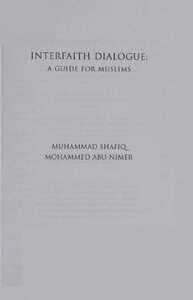
Interfaith Dialogue: A Guide For Muslims

Account upgrade
The download is free, but we offer some paid services. Support us by subscribing
Delete ads and speed up browsing the library.
The download starts with the click of a button without waiting for the book to be ready.
No limits for download times.
You can upload unlimited books in the library.
Enable readers to download your books without waiting.
Delete ads on the books that you publish.
No problems with download links for your uploaded books.
Book Interfaith Dialogue A Guide For Muslims
Copyright reserved
The book cannot be previewed or downloaded in order to preserve the copyright of the author and publishing house
Not available digitally or on paper through the Noor Library, it is for rating and review



Interfaith Dialogue: A Guide For Muslims
| Author: | Muhammad Shafiq ؛ Mohammed Abu-Nimer |
| Category: | Arabic Islamic Literature [Edit] |
| Language: | English |
| Publisher: | المعهد العالمي للفكر الاسلامي |
| Release Date: | 01 Jan 2017 |
| Rank: | 634,385 No 1 most popular |
| Short link: | Copy |
| More books like this book | |
Book Description
Islam recognizes a plurality of religions and asks Muslims to respect other religions. The primary role of interfaith dialogue is to remove misunderstanding and accept difference, the aim being to generate a climate of peaceful coexistence and harmonious social relations. And this is perhaps more needed today than ever before, as mankind is increasingly called upon to exercise tolerance in a markedly volatile world, where living and working together in diversity is fast becoming the norm. Interfaith dialogue is by no means easy, defensive reaction. uncomfortable exchange and an overwhelming desire to avoid a perceived compromise of deeply held principles are some of the pitfalls that can easily cool commitment and the best of endeavors. It is here that this Guide makes an important contribution. The book is designed to guide Muslims who are interested and/or involved in building relations with those of the Jewish and Christian faiths.Muhammad Shafiq is a visiting professor of Islamic and religious studies and the executive director of the Center for Interfaith Studies and Dialogue, Nazareth College, Rochester, New York. He is also executive director and imam of the Islamic Center of Rochester and an active participant in several interfaith forums. He has published over forty articles and several books, among them “The Growth of Islamic Thought in North America” (amana publications: 1994).Mohammed Abu-Nimer is a professor at International Peace and Conflict Resolution (IPCR) and the director of the Peacebuilding and Development Institute, American University. He is also a co-founder and director of the Salam Institute for Peace and Justice. He has worked for over two decades on interfaith dialogue and peacebuilding in the United States and many parts of the Muslim world. His recent publications include “Unity and Diversity: Interfaith Dialogue in the Middle East” (USIP Press: 2007). (2011).

Copyright reserved
The book cannot be previewed or downloaded in order to preserve the copyright of the author and publishing house
Not available digitally or on paper through the Noor Library, it is for rating and review
Share the book :
Book Review "Interfaith Dialogue: A Guide For Muslims"

Book Quotes "Interfaith Dialogue: A Guide For Muslims"

Other books like "Interfaith Dialogue: A Guide For Muslims"







If there is a problem with the book, please report through one of the following links:
Report the book or by Contact us
E-books are complementary and supportive of paper books and never cancel it. With the click of a button, the e-book reaches anyone, anywhere in the world.
E-books may weaken your eyesight due to the glare of the screen. Support the book publisher by purchasing his original paper book. If you can access it and get it, do not hesitate to buy it.
Publish your book now for free