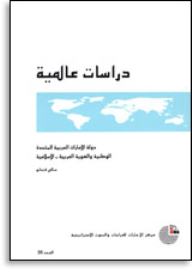
The United Arab Emirates: Nationalism And Arab - Islamic Identiy

Account upgrade
The download is free, but we offer some paid services. Support us by subscribing
Delete ads and speed up browsing the library.
The download starts with the click of a button without waiting for the book to be ready.
No limits for download times.
You can upload unlimited books in the library.
Enable readers to download your books without waiting.
Delete ads on the books that you publish.
No problems with download links for your uploaded books.
Book The United Arab Emirates Nationalism And Arab Islamic Identiy
Copyright reserved
The book cannot be previewed or downloaded in order to preserve the copyright of the author and publishing house
Not available digitally or on paper through the Noor Library, it is for rating and review



The United Arab Emirates: Nationalism And Arab - Islamic Identiy
| Author: | Sally Findlow |
| Category: | Arab Nationalism [Edit] |
| Language: | English |
| Publisher: | مركز الإمارات للدراسات والبحوث السلسلة: THE EMIRATES OCCASIONAL PAPERS |
| ISBN: | 9948000161 |
| Release Date: | 01 Jan 2000 |
| Pages: | 88 |
| Rank: | 487,835 No 1 most popular |
| Short link: | Copy |
| More books like this book | |
Book Description
There is a wide diversity of identity constructs in the Muslim world, and within the Arab- Muslim world. Despite wide acknowledgment of this fact, mush of the recent debate on modern Muslim identity has tended to be based on narrowly defined images. An instance of such a narrow definition is that which to a large extent formed the assumption behind debates on Islamic identity presented at the 1998 International Conference on Muslim Identity in the 21st Century held in London. Here, although this was not a declared aim of the conference, discussion focused almost exclusively on the experiences of immigrant Muslims in the United Kingdom and United States. Since these same people constituted the majority of presenters and delegates, and the conference took place in the United Kingdom, this was to an extent understandable. However, the limited perspective failed to do justice what should have been a discussion of the whole range of modern Muslim identities. Moreover, these diverse identities were largely unacknowledged and to this extent, the perspective offered tended to be misleading. The way in which the national identity of the modern United Arab Emirates (UAE) has evolved, illustrates the inadequacy of such monolithic pictures. The example of the UAE is presented here in the context of my wider research into higher education and identity issues. Furthermore, its radically different circumstance from that which formed the context of debate in the aforementioned conference serve ideally to highlight the inadequacy outlined earlier. Emirati concepts of self and national identity challenge the vague but monolithic pictures of modern Muslim identity often found in literature pertaining to Islamic studies, whether from the Orientalist, non- Orientalist and Islamic Science perspectives or in the media generally.

Copyright reserved
The book cannot be previewed or downloaded in order to preserve the copyright of the author and publishing house
Not available digitally or on paper through the Noor Library, it is for rating and review
Share the book :
Book Review "The United Arab Emirates: Nationalism And Arab - Islamic Identiy"

Book Quotes "The United Arab Emirates: Nationalism And Arab - Islamic Identiy"

Other books like "The United Arab Emirates: Nationalism And Arab - Islamic Identiy"





If there is a problem with the book, please report through one of the following links:
Report the book or by Contact us
E-books are complementary and supportive of paper books and never cancel it. With the click of a button, the e-book reaches anyone, anywhere in the world.
E-books may weaken your eyesight due to the glare of the screen. Support the book publisher by purchasing his original paper book. If you can access it and get it, do not hesitate to buy it.
Publish your book now for free