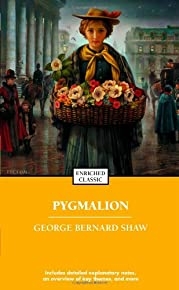
Pygmalion - Literary Touchstone Classic

Account upgrade
The download is free, but we offer some paid services. Support us by subscribing
Delete ads and speed up browsing the library.
The download starts with the click of a button without waiting for the book to be ready.
No limits for download times.
You can upload unlimited books in the library.
Enable readers to download your books without waiting.
Delete ads on the books that you publish.
No problems with download links for your uploaded books.
Book Pygmalion Literary Touchstone Classic
Copyright reserved
The book cannot be previewed or downloaded in order to preserve the copyright of the author and publishing house
Not available digitally or on paper through the Noor Library, it is for rating and review



Pygmalion - Literary Touchstone Classic
| Author: | George Bernard Shaw George Bernard ... |
| Category: | Literary Commentary Translated [Edit] |
| Language: | English |
| Publisher: | Prestwick House Inc. |
| ISBN: | 1580493998 |
| Release Date: | 01 Jan 2005 |
| Rank: | 659,311 No 1 most popular |
| Short link: | Copy |
| More books like this book | |
Book Description
This Prestwick House Literary Touchstone Classic includes a glossary and reader's notes to help the modern reader appreciate Shaw's wit and cynicism. In this delightful romance about the man too self-centered to fall in love and the woman too unsure of herself to want more out of life than the little she already has, George Bernard Shaw shakes the dust off the Cinderella story and tells it as only he can. Eliza Doolittle, the Cockney flower girl who wants to work in a flower shop, and Henry Higgins, the phoneticist who turns her into a princess, are no mythological knight and maiden. Instead, even today, they resound with sharp humor and cutting dialogue. Originally published in 1914, Pygmalion invites readers and audience members to examine the roots of social prejudice and the true value of a human being, while also involving them in the improbable lives of Shaw's one-dimensional, yet endearing characters. From the Publisher Pygmalion was originally a play written for the stage by George Bernard Shaw in 1913. It was a typical five-act play: Act I taking place in the street outside of Covent Garden Theater; Act II taking place in the library of Henry Higgins s home on Wimpole Street. Act III takes place in the drawing room of Higgins s mother at her at-home. Act IV returns to Higgins s home, and Act V returns to Mrs. Higgins s drawing room. There are, in all, three sets: the London street, Higgins s library, and Mrs. Higgins s drawing room. The 1913 stage play is the version reproduced in the Prestwick House Literary Touchstone. It is interesting to note that, after theater audiences and critics complained about the ambiguous ending of the 1913 stage play and the apparent lack of a happy ending, Shaw wrote an epilogue, which is included in the Touchstone edition. In this epilogue, Shaw narrates the events of the years following the close of the play. Eliza marries Freddy. He drops the Eynsford from his name and with financial assistance from Colonel Pickering opens a green-grocer shop. Eliza, also with Pickering s help, opens a florist shop next door to Freddy. The couple remains close friends with the Colonel and Higgins, neither of whom ever marry. In 1938, Shaw adapted his stage play for the screen. This film version of Pygmalion starred Leslie Howard as Higgins and Wendy Hiller as Eliza. There are several notable differences between the 1913 stage play and the 1938 screenplay. While the stage play has a decidedly Victorian flavor, the screen play is definitely twentieth-century. Whereas in the stage play, Higgins and Pickering intend to take Eliza to an ambassador s garden party, in the screenplay, they take her to an embassy ball. The movie also presents the scene of Eliza s triumph at the ball, which the play does not. To do so in the play would have required an additional set change, costume changes, and a host of stage extras, all of which Shaw and his producer apparently deemed unnecessary. Probably the most significant difference between the 1913 stage play and the 1938 screen play, however, is the ending. Shaw s epilogue must not have satisfied the public, as, at the end of the 1938 movie, Eliza returns to Higgins. It is the 1938 screenplay that served as the basis for the 1956 stage musical and the 1964 movie musical, My Fair Lady. Again, however, there were significant changes. The visit to Mrs. Higgins s home in Act III becomes a visit to the Ascot Racecourse. The role of Eliza s father and his marriage in Act V are greatly expanded. How Eliza spends the night after the embassy ball is expanded, and so on.

Copyright reserved
The book cannot be previewed or downloaded in order to preserve the copyright of the author and publishing house
Not available digitally or on paper through the Noor Library, it is for rating and review
Share the book :
Book Review "Pygmalion - Literary Touchstone Classic"

Book Quotes "Pygmalion - Literary Touchstone Classic"

Other books like "Pygmalion - Literary Touchstone Classic"




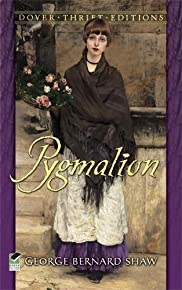
Other books for "George Bernard Shaw George Bernard ..."


If there is a problem with the book, please report through one of the following links:
Report the book or by Contact us
E-books are complementary and supportive of paper books and never cancel it. With the click of a button, the e-book reaches anyone, anywhere in the world.
E-books may weaken your eyesight due to the glare of the screen. Support the book publisher by purchasing his original paper book. If you can access it and get it, do not hesitate to buy it.
Publish your book now for free