The Maudsley: Prescribing Guidelines In Psychiatry

Account upgrade
The download is free, but we offer some paid services. Support us by subscribing
Delete ads and speed up browsing the library.
The download starts with the click of a button without waiting for the book to be ready.
No limits for download times.
You can upload unlimited books in the library.
Enable readers to download your books without waiting.
Delete ads on the books that you publish.
No problems with download links for your uploaded books.
Download Book The Maudsley Prescribing Guidelines In Psychiatry Pdf
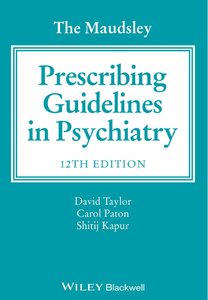

The Maudsley: Prescribing Guidelines In Psychiatry
| Author: | David Taylor |
| Category: | Medical Sciences [Edit] |
| Language: | English |
| Publisher: | Wiley Blackwell |
| ISBN: | 2014049389 |
| Release Date: | 01 Jan 2015 |
| Pages: | 758 |
| File Size: | 2.46 MB |
| Extension: | |
| Creation Date: | 09 May 2015 |
| Rank: | 179,468 No 1 most popular |
| Short link: | Copy |
| More books like this book | |

Mohamed Irhuma
Professor
The Publisher and not the author Book The Maudsley: Prescribing Guidelines In Psychiatry .
As a Professor in Clinical Pharmacology, an academic researcher, and a physician, my professional journey has uniquely positioned me at the nexus of scientific rigour and holistic well-being. My work transcends conventional medical boundaries, delving into the philosophical underpinnings of Islamic thought, particularly as they relate to human health and spiritual [Imaan] flourishing. My research often explores how the sacred Islamic principles, such as those found in the rich Prophetic Sunnah, can inform contemporary medical ethics and practice. I aim to offer a nuanced perspective on healing that encompasses both body and soul [Imaan], acknowledging the Sunnah's role as a "divinely preserved legacy" that "elucidates the Qur’an’s commands" and guides a complete way of life. This interdisciplinary approach, deeply rooted in both empirical science and the true rich heritage of Islamic philosophy, underpins my writing, bridging the gap between faith [ISLAM] and evidence-based knowledge.
Book Description
This 12th edition of The Maudsley Prescribing Guidelines in Psychiatry marks its 20th year in continuous production. Readers who have owned or used previous editions will find this edition no different in style from previous incarnations. This is deliberate – the feedback we receive suggests the organisation and structure are well liked.
Each section of The Guidelines is a densely referenced but succinct review of the literature, set alongside some fairly broad recommendations for practice. Each of these sections has been updated and revised, and some new ones added (for example, interpreting clozapine plasma levels, post‐mortem plasma levels, summary of depot pharmacokinetics). Much of the guidance provided in this edition has changed as a result of more recent research; some of it to a small extent, some of it to an extent amounting to a reversal of prior guidance (for example, on the use of fish oils in psychosis).
These changes reflect the very nature of the scientific method – that hypotheses come and go as evidence mounts or is countered.
This edition of The Guidelines has a particularly international flavour. This is because the 11th edition sold more copies outside the UK than in it, and because there are, we think, at least ten translations of The Guidelines in existence. Although
The Guidelines are still essentially our local guide to prescribing, we have made a special effort to widen, geographically speaking, its utility. This is most noticeable in the inclusion of drugs not licensed in the UK (e.g. ziprasidone, iloperidone, desvenlafaxine), but widely used in other countries. Readers should, therefore, not assume that every drug mentioned in The Guidelines is available in their own country.
The reader should also be aware that no guideline could take account of every psychotropic drug used around the world, so omissions are inevitable.
As with previous editions, very special thanks are due to Maria O’Hagan who manages the writing and structuring of The Guidelines; an increasingly complex process given the size, complexity and heavily referenced nature of the current edition.


Share the book :

Book Quotes "The Maudsley: Prescribing Guidelines In Psychiatry"

Other books like "The Maudsley: Prescribing Guidelines In Psychiatry"







If there is a problem with the book, please report through one of the following links:
Report the book or by Contact us
E-books are complementary and supportive of paper books and never cancel it. With the click of a button, the e-book reaches anyone, anywhere in the world.
E-books may weaken your eyesight due to the glare of the screen. Support the book publisher by purchasing his original paper book. If you can access it and get it, do not hesitate to buy it.
Publish your book now for free