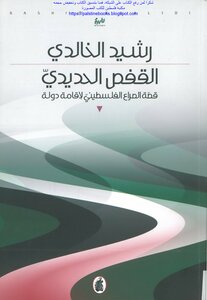
The Iron Cage: The Story Of The Palestinian Struggle For Statehood

Account upgrade
The download is free, but we offer some paid services. Support us by subscribing
Delete ads and speed up browsing the library.
The download starts with the click of a button without waiting for the book to be ready.
No limits for download times.
You can upload unlimited books in the library.
Enable readers to download your books without waiting.
Delete ads on the books that you publish.
No problems with download links for your uploaded books.
Book The Iron Cage The Story Of The Palestinian Struggle For Statehood
Copyright reserved
The book cannot be previewed or downloaded in order to preserve the copyright of the author and publishing house
Not available digitally or on paper through the Noor Library, it is for rating and review



The Iron Cage: The Story Of The Palestinian Struggle For Statehood
| Author: | Rashid Khalidi |
| Category: | The Palestinian-Israeli Conflict And The Liberation Of Jerusalem And Palestine [Edit] |
| Language: | English |
| Publisher: | Beacon Press |
| Release Date: | 01 Jan 2006 |
| Rank: | 559,266 No 1 most popular |
| Short link: | Copy |
| More books like this book | |
Book Description
Named an outstanding title of 2006 by Publishers Weekly At a time when a lasting peace between the Palestinians and the Israelis seems virtually unattainable, understanding the roots of their conflict is an essential step in restoring hope to the region. In The Iron Cage, Rashid Khalidi, one of the most respected historians and political observers of the Middle East, homes in on Palestinian politics and history. By drawing on a wealth of experience and scholarship, Khalidi provides a lucid context for the realities on the ground today, a context that has been, until now, notably lacking in our discourse. The story of the Palestinian search to establish a state begins in the mandate period immediately following the breakup of the Ottoman Empire, the era of British control, when fledgling Arab states were established by the colonial powers with assurances of eventual independence. Mandatory Palestine was a place of real promise, with unusually high literacy rates and a relatively advanced economy. But the British had already begun to construct an iron cage to hem in the Palestinians, and the Palestinian leadership made a series of errors that would eventually prove crippling to their dream of independence. The Palestinians’ struggle intensified in the stretch before and after World War II, when colonial control of the region became increasingly unpopular, population shifts began with heavy Jewish immigration from Eastern Europe, and power began to devolve to the United States. In this crucial period, Palestinian leaders continued to run up against the walls of the ever-constricting iron cage. They proved unable to achieve their long-cherished goal of establishing an independent statea critical failure that set a course for the decades that followed, right through the eras of the Palestinian Liberation Organization, the Palestinian Authority, and Hamas. Rashid Khalidi’s engrossing narrative of this torturous history offers much-needed perspective for anyone concerned about peace in the Middle East. In his new book The Iron Cage Rashid Khalidi uses history to provide a clear-eyed view of the region and assess the prospects for peace .He strives successfully for even-handedness He’s fair to both sides, and in particular, he’s knowledgeable not only about Palestinian history but about what he has called tragic Jewish history.” Anthony Lewis Dr. Rashid Khalidi, author of Resurrecting Empire and Palestinian Identity, holds the Edward Said Chair in Arab Studies at Columbia University, where he heads the Middle East Institute. He has written more than eighty articles on Middle Eastern history and politics, as well as op-ed pieces in the New York Times, the Boston Globe, the Los Angeles Times, the Chicago Tribune, and The Nation. He lives in New York. Praise for Resurrecting Empire Mr. Kahlidi’s book will certainly be useful to all those outside the region who are engaged in the difficult yet crucial task of devising ways to help foster change in the Middle East.” Ivo H. Daalder, New York Times Khalidi makes a powerful case for a more evenhanded policy toward the Israeli-Palestinian conflictand for the rejection of the dangerous ambition of making the United States an imperial power in the Middle East.” Warren I. Cohen, Los Angeles Times With a deep knowledge of the Middle East and a felicitous literary style, Khalidi . . . examines the history of U.S. involvement in the area against the backdrop of European colonialism and shows why an assertion of our good intentions has little meaning for peoples who have known two centuries of foreign occupation and domination.” Ronald Steel, The Nation Khalidi, armed with a deep knowledge of the region, demonstrates that the legacy of past empires has conditioned present-day Middle Easterners to resist outside control, direct or indirect.” L. Carl Brown, Foreign Affairs Khalidi brings firsthand knowledge and an extensive historical backgrouund to a topic where such insight is needed more than ever.” Joseph Stiglitz, winner of the Nobel Prize, author of The Roaring Nineties

Copyright reserved
The book cannot be previewed or downloaded in order to preserve the copyright of the author and publishing house
Not available digitally or on paper through the Noor Library, it is for rating and review
Share the book :
Book Review "The Iron Cage: The Story Of The Palestinian Struggle For Statehood"

Book Quotes "The Iron Cage: The Story Of The Palestinian Struggle For Statehood"

Other books like "The Iron Cage: The Story Of The Palestinian Struggle For Statehood"







Other books for "Rashid Khalidi"


If there is a problem with the book, please report through one of the following links:
Report the book or by Contact us
E-books are complementary and supportive of paper books and never cancel it. With the click of a button, the e-book reaches anyone, anywhere in the world.
E-books may weaken your eyesight due to the glare of the screen. Support the book publisher by purchasing his original paper book. If you can access it and get it, do not hesitate to buy it.
Publish your book now for free