Black Holes And Time Warps: Einstein's Outrageous Legacy (Commonwealth Fund Book Program)

Account upgrade
The download is free, but we offer some paid services. Support us by subscribing
Delete ads and speed up browsing the library.
The download starts with the click of a button without waiting for the book to be ready.
No limits for download times.
You can upload unlimited books in the library.
Enable readers to download your books without waiting.
Delete ads on the books that you publish.
No problems with download links for your uploaded books.
Book Black Holes And Time Warps Einstein 39 S Outrageous Legacy Commonwealth Fund Book Program
Copyright reserved
The book cannot be previewed or downloaded in order to preserve the copyright of the author and publishing house
Not available digitally or on paper through the Noor Library, it is for rating and review

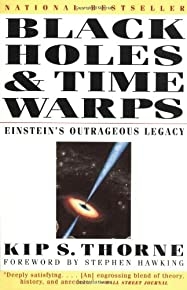

Black Holes And Time Warps: Einstein's Outrageous Legacy (Commonwealth Fund Book Program)
| Author: | Kip S. Thorne |
| Category: | F Sharp Language #F [Edit] |
| Language: | English |
| Publisher: | W. W. Norton & Company |
| ISBN: | 393312763 |
| Release Date: | 01 Jan 1995 |
| Rank: | 441,350 No 1 most popular |
| Short link: | Copy |
| More books like this book | |
Book Description
Ever since Albert Einstein's general theory of relativity burst upon the world in 1915 some of the most brilliant minds of our century have sought to decipher the mysteries bequeathed by that theory, a legacy so unthinkable in some respects that even Einstein himself rejected them. Which of these bizarre phenomena, if any, can really exist in our universe? Black holes, down which anything can fall but from which nothing can return; wormholes, short spacewarps connecting regions of the cosmos; singularities, where space and time are so violently warped that time ceases to exist and space becomes a kind of foam; gravitational waves, which carry symphonic accounts of collisions of black holes billions of years ago; and time machines, for traveling backward and forward in time. Kip Thorne, along with fellow theorists Stephen Hawking and Roger Penrose, a cadre of Russians, and earlier scientists such as Oppenheimer, Wheeler and Chandrasekhar, has been in the thick of the quest to secure answers. In this masterfully written and brilliantly informed work of scientific history and explanation, Dr. Thorne, the Feynman Professor of Theoretical Physics at Caltech, leads his readers through an elegant, always human, tapestry of interlocking themes, coming finally to a uniquely informed answer to the great question: what principles control our universe and why do physicists think they know the things they think they know? Stephen Hawking's A Brief History of Time has been one of the greatest best-sellers in publishing history. Anyone who struggled with that book will find here a more slowly paced but equally mind-stretching experience, with the added fascination of a rich historical and human component.

Copyright reserved
The book cannot be previewed or downloaded in order to preserve the copyright of the author and publishing house
Not available digitally or on paper through the Noor Library, it is for rating and review
Share the book :
Book Review "Black Holes And Time Warps: Einstein's Outrageous Legacy (Commonwealth Fund Book Program)"

Book Quotes "Black Holes And Time Warps: Einstein's Outrageous Legacy (Commonwealth Fund Book Program)"

Other books like "Black Holes And Time Warps: Einstein's Outrageous Legacy (Commonwealth Fund Book Program)"







If there is a problem with the book, please report through one of the following links:
Report the book or by Contact us
E-books are complementary and supportive of paper books and never cancel it. With the click of a button, the e-book reaches anyone, anywhere in the world.
E-books may weaken your eyesight due to the glare of the screen. Support the book publisher by purchasing his original paper book. If you can access it and get it, do not hesitate to buy it.
Publish your book now for free