books improving the productivity of ak x well in asa ad al kamil field
If you do not find what you're looking for, you can use more accurate words.
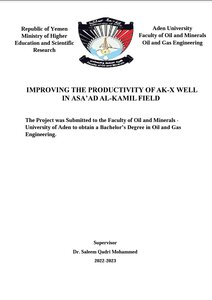
IMPROVING THE PRODUCTIVITY OF AK-X WELL IN ASA’AD AL-KAMIL FIELD (Book)
The hydraulic test of oil and gas wells is used in evaluating the performance of production wells. It involves measuring the flow rate and different pressures. After that it processed the results of this test in order to achieve the objective of the test. The most important of which is the optimization of the production rate and determination of the well's production and others. AK-X Well data in Asa’ad Al-kamil field showed that the type of rock is a compacted sandstone rock. This shows why there is a little amount of sand in the oil stream produced from this well causing it to deposit in the bottom of the well. Through the data we obtained the percentage of salt in the associated water with oil production in Asa’ad Al-kamil field, where it showed that it contained a high percentage of inorganic salt soluble in water deposited on the perforation holes of the production tube and on the valves. In our study, well tests were carried out on the oil production wells of the AK-X well in the Asa’ad Al-kamil field by using Kappa Saphir oil program V4.02. The results were obtained from this program and matched with the results obtained by the use of mathematical equations and the Excel program. The results were very close. This indicates the validity of the analysis of the data and through these results the damage to the wellbore area was observed by the skin factor which equals 6.03. In our research, we treated the sand deposits by using screen to place them against holes in the well wall. The screen is part of tubing. Salt deposits have been treated with a fresh water injection in two cases: 1. During well flowing: fresh water is injected during the annular space and entered through the RCV into the production tube, thereby dissolving salts in the production tube and in the surface chock. 2. When the well is closed: fresh water is injected through the annular space and entered through the RCV into the production tube and then into the well bottom area where the injection is made at a rate of 15-10 barrels per hour for 10-12 hours After that, the well is closed for two days to dissolve the salts deposits on the perforated area and inside the production pipe. Then well is opened and the contaminated salt water is disposed to the flare pit at the desert to the atmospheric pressure, to push out the salty water or contaminated to the desert. After that the well diverted to production process. The result of this treatment process was improving the productivity to 56 STB/Day in June 2019 after it was 39 STB/Day in May 2019.