Religion And Politics In America

Account upgrade
The download is free, but we offer some paid services. Support us by subscribing
Delete ads and speed up browsing the library.
The download starts with the click of a button without waiting for the book to be ready.
No limits for download times.
You can upload unlimited books in the library.
Enable readers to download your books without waiting.
Delete ads on the books that you publish.
No problems with download links for your uploaded books.
Book Religion And Politics In America
Copyright reserved
The book cannot be previewed or downloaded in order to preserve the copyright of the author and publishing house
Not available digitally or on paper through the Noor Library, it is for rating and review

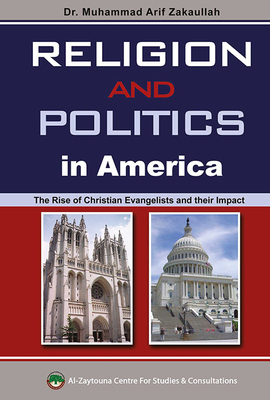

Religion And Politics In America
| Author: | Muhammad Arif Zakaullah |
| Category: | South America Continent [Edit] |
| Language: | English |
| Publisher: | مركز الزيتونة للدراسات والاستشارات |
| Release Date: | 01 Apr 2007 |
| Pages: | 159 |
| Rank: | 664,699 No 1 most popular |
| Short link: | Copy |
| More books like this book | |
Book Description
It was hoped that in the post colonial era the relationship between the Muslim world and the powerful west would improve and mutual respect and care for each other’s concerns would become the guiding principles of western policy towards the Muslim world. However, the post colonial experience of nearly half a century leaves a lot more to be desired. The pain, suffering and humiliation suffered by the Muslim peoples during the last half a century, and the helplessness of the Muslim governments and leaders has created a sense of disappointment and hopelessness amongst the Muslim masses. This situation has been exploited by extremists in both camps endangering world peace in the first decade of the 21st century.
Let us begin by asking the fundamental question: why has the Muslim world failed to communicate with the west and change its colonialist attitude? The response to this question comes mainly from two schools of thought. First, there is the most commonly accepted view which holds that the west is powerful and arrogant and hence there is no way to change its attitude. The advocates of this view may cite hundreds of examples of Muslim governments which always unconditionally support the west, and yet the west, despite legitimizing their roles and labeling them as allies, does not reciprocate by extending similar support to Muslim causes in return. This situation is further aggravated when the west shows little respect for the UN resolutions in support of Muslim causes.
Hundreds if Universities in the west offer programs of study on Islam, Muslim societies and Muslim regions. These programs are backed by rich libraries, experts, academics, and diplomats. Top universities in the United States, Canada, Europe and Australia take pride in offering undergraduate and doctoral programs focused on Islam and Muslim world. They have well endowed departments and institutions which gather the best experts who are provided with all the resources needed to pursue the scholarly agenda. Unfortunately the reality in the Muslim world is quite the contrary. There are hardly any good programs on American/European studies, Christianity and/or contemporary western civilization in the Muslim world. Similarly a world class research institute entirely focused on the study of U.S./West is non-existent in the Muslim world.
Instead of totally shelving the proposal to introduce the American/European studies due to lack of staff to establish relevant departments, the Universities in the Muslim world can also make a beginning at the undergraduate level by using the Stanford Public Policy program model. Currently the universities in the Muslim world are offering undergraduate courses on the west through various departments e.g. political science, history, economics etc. The faculty members belonging to various departments and offering these courses can be asked to develop a minor/concentration package for the undergraduates with a focus on American/European studies. This minor should be available to a wider student body in arts, humanities and social sciences and be taught by the faculty members from the respective departments (e.g. history, political science, economics, mass communication, etc.). This approach is not perfect and may have its own shortcomings, but once these minors/concentrations are offered they will generate their own dynamics and with insights gained over time, improvements can be made. With this experience the programs can be further expanded or advanced. Once such minors/concentrations are introduced in the universities at the undergraduate level they will generate their own demand for qualified professionals in these areas and more young people would choose to specialize in these fields in their graduate studies. It is hoped that given serious consideration by the institutions of higher learning throughout the Muslim world.

Copyright reserved
The book cannot be previewed or downloaded in order to preserve the copyright of the author and publishing house
Not available digitally or on paper through the Noor Library, it is for rating and review
Share the book :
Book Review "Religion And Politics In America"

Book Quotes "Religion And Politics In America"

Other books like "Religion And Politics In America"





If there is a problem with the book, please report through one of the following links:
Report the book or by Contact us
E-books are complementary and supportive of paper books and never cancel it. With the click of a button, the e-book reaches anyone, anywhere in the world.
E-books may weaken your eyesight due to the glare of the screen. Support the book publisher by purchasing his original paper book. If you can access it and get it, do not hesitate to buy it.
Publish your book now for free