THE CONCEPT OF THE ISLAMIC STATE

Account upgrade
The download is free, but we offer some paid services. Support us by subscribing
Delete ads and speed up browsing the library.
The download starts with the click of a button without waiting for the book to be ready.
No limits for download times.
You can upload unlimited books in the library.
Enable readers to download your books without waiting.
Delete ads on the books that you publish.
No problems with download links for your uploaded books.
Book The Concept Of The Islamic State
Copyright reserved
The book cannot be previewed or downloaded in order to preserve the copyright of the author and publishing house
Not available digitally or on paper through the Noor Library, it is for rating and review

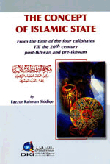

THE CONCEPT OF THE ISLAMIC STATE
| Author: | فزور رحمن صديق |
| Category: | Islamic Sharia Provisions [Edit] |
| Language: | English |
| Publisher: | دار الكتب العلمية |
| Release Date: | 23 May 2009 |
| Pages: | 224 |
| Rank: | 525,815 No 1 most popular |
| Short link: | Copy |
| More books like this book | |
Book Description
This thesis attempts to explore and investigates the idea of Islamic state in the writing of Sayyed Qutb- a leading thicker and activities of late 20th century Muslim world. It analyzes the intricate relationship between theoretical and epistemological foundation of his Islamic discourses and the prevailing domestic socio-political and cultural, political, regional and global context of his time.
Sayyed Qutb, more than any other thinker in Egypt of his time, articulated a conception of Islam that consciously attempted to lay the foundation of Islamic epistemology on the basis of Islamic ontology, denied the authority of foreign life conception, claimed for Islamic universal validity, asserted the character of truly Muslim, decried the economic injustice which the masses were enduring and rejected the traditional conception of state as intrinsically benevolent..
In addition Qutb called upon the Muslims to look to the Prophet’s life as direct example of Islamic virtue and he instructed the devout to use the Prophet’ action and words as a collective action framework.
The procedure and method employed to undertake the study of the proposed subject matter broadly consists of there principle approaches: the historical, analytical and comparative. As to the first approach, this study will review and analyze the historical origin of Islamic state and its development at different phase of history; the second approach will be employed to study the development of Islamic political thoughts of Sayyed Qutb. The various external and internal, political, social, economic and cultural factors that had been very instrumental in shaping the ideas of his 20th century revolutionary thinkers of the Arab world would be firmly taken into account.
At last, the comparative approach has been utilized to compare the Islamic political thoughts of different Islamic ideologue and to see how their tone, pace, intensity, preference, vocabulary, idiom and phrases differ from each other according to the existing geographical, political, economic, social and cultural environment they were representing.
The author has divided his thesis into five chapters. The first chapter focuses on the study of various dominant theories of Islamic state in classical and medieval period. Second chapter broadly deals with dominant theories of Islamic state in modern period since the Napoleonic invasion of Egypt. The third chapter consists of the study of Qutb’s life as a writer, poet and critics. Fourth chapter deals with his association with Muslim Brotherhood, his ideological response to Nasserism, communism and capitalism and finally a comprehensive analysis of his concept of Islamic state. The fifth and last chapter comprises of a comparison between Qutb and some of his contemporaries like Sayyed Abu- Ala Mawdudi, the founder of Jamait- e Islami Imam Rohollah Ayatollah Khomeini of Iran and Hassan Abdullah of Sudan.
In conclusion, the author summarized the basic content of this entire thesis with certain critical remark on the idea and the concept of Islamic state as conceptualized by Sayyed Qutb in his political- Islamic writings.

Copyright reserved
The book cannot be previewed or downloaded in order to preserve the copyright of the author and publishing house
Not available digitally or on paper through the Noor Library, it is for rating and review
Share the book :
Book Review "THE CONCEPT OF THE ISLAMIC STATE"

Book Quotes "THE CONCEPT OF THE ISLAMIC STATE"

Other books like "THE CONCEPT OF THE ISLAMIC STATE"








Other books for "فزور رحمن صديق"
![The Idea Of An Islamic State [english]](/publice/covers_cache_jpg/16/7/c/5/83c983b5567c56e0f1b2b9af42282b6a.jpg.jpg "The Idea Of An Islamic State [english]")
If there is a problem with the book, please report through one of the following links:
Report the book or by Contact us
E-books are complementary and supportive of paper books and never cancel it. With the click of a button, the e-book reaches anyone, anywhere in the world.
E-books may weaken your eyesight due to the glare of the screen. Support the book publisher by purchasing his original paper book. If you can access it and get it, do not hesitate to buy it.
Publish your book now for free