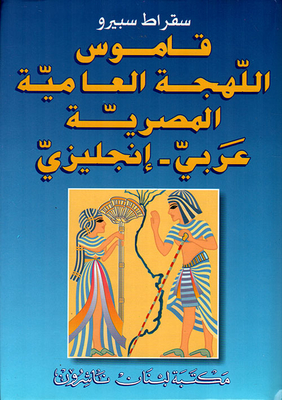
Egyptian Colloquial Dictionary: English - Arabic

Account upgrade
The download is free, but we offer some paid services. Support us by subscribing
Delete ads and speed up browsing the library.
The download starts with the click of a button without waiting for the book to be ready.
No limits for download times.
You can upload unlimited books in the library.
Enable readers to download your books without waiting.
Delete ads on the books that you publish.
No problems with download links for your uploaded books.
Book Egyptian Colloquial Dictionary English Arabic
Copyright reserved
The book cannot be previewed or downloaded in order to preserve the copyright of the author and publishing house
Not available digitally or on paper through the Noor Library, it is for rating and review

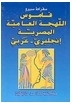

Egyptian Colloquial Dictionary: English - Arabic
| Author: | سقراط سبيرو |
| Category: | Vernacular Poetry [Edit] |
| Language: | Arabic |
| Publisher: | Librairie du Liban, Beirut (first published 1974) |
| Release Date: | 01 Jan 1974 |
| Rank: | 207,769 No 1 most popular |
| Short link: | Copy |
| More books like this book | |
Book Description
Spiro's work was initially intended to serve foreign residents in Egypt, foreign officials in the service of the Egyptian government, and winter tourists. Foreign residents and foreign officials are far fewer than they used to be; so are the leisurely tourists who are likely to take trouble to learn the local idiom. Yet the number of potential users of this dictionary-especially of those who are likely to make sustained and serious use of it-has increased rather than diminished. Businessmen and diplomats will find obvious advantages in it. Specialists in various branches of linguistics will want to exploit it. Folklorists will use it as a key to a vast treasure-house whose anthropological, sociological, and literary value has too long been ignored. And even the general student of Arab thought and Arab affairs will have to reckon with the fact that the colloquial has for some time now been part and parcel of elitist writing. Many significant plays are entirely in the colloquial; the dialogue of innumerable novels and short stories is in the colloquial; some good poetry is being writen in the colloquial. Even writers resolutely opposed to making the colloquial into ''the language of literature'' such as Najib Mahfuz borrow from it purely local words such as Wikala (a low-class in including accommodation for pack-animals) the meaning of wich is unknown even to Arabs from other regions, can not be deduced from the classical root, and does not appear to have been recorded in any dictionary other than Spiro's.
A very welcome feature of Spiro's dictionary is that it is not content with literal translations but pays considerable attention to idiomatic usages.

Copyright reserved
The book cannot be previewed or downloaded in order to preserve the copyright of the author and publishing house
Not available digitally or on paper through the Noor Library, it is for rating and review
Share the book :
Book Review "Egyptian Colloquial Dictionary: English - Arabic"

Book Quotes "Egyptian Colloquial Dictionary: English - Arabic"

Other books like "Egyptian Colloquial Dictionary: English - Arabic"
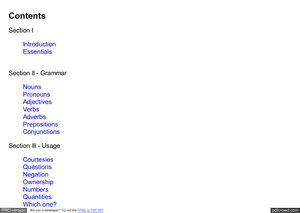
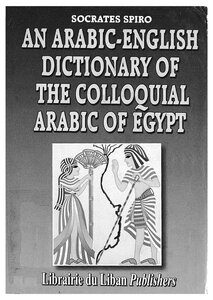





Other books for "سقراط سبيرو"
If there is a problem with the book, please report through one of the following links:
Report the book or by Contact us
E-books are complementary and supportive of paper books and never cancel it. With the click of a button, the e-book reaches anyone, anywhere in the world.
E-books may weaken your eyesight due to the glare of the screen. Support the book publisher by purchasing his original paper book. If you can access it and get it, do not hesitate to buy it.
Publish your book now for free