A Letter on Ruling By Man Made Laws Muhammad Ibn Ibrahim رسالة تحكيم القوانين انجليزي

Account upgrade
The download is free, but we offer some paid services. Support us by subscribing
Delete ads and speed up browsing the library.
The download starts with the click of a button without waiting for the book to be ready.
No limits for download times.
You can upload unlimited books in the library.
Enable readers to download your books without waiting.
Delete ads on the books that you publish.
No problems with download links for your uploaded books.
Download Book A Letter On Ruling By Man Made Laws Muhammad Ibn Ibrahim رسالة تحكيم القوانين انجليزي Pdf
The publisher is the author
Previewing the book or downloading it for personal use only and any other powers should be obtained from the author of the book publisher



A Letter On Ruling By Man Made Laws Muhammad Ibn Ibrahim رسالة تحكيم القوانين انجليزي
| Author: | Ali Bin Muhammad Shariqi |
| Category: | The Holy Quran [Edit] |
| Language: | English |
| Pages: | 22 |
| File Size: | 2.17 MB |
| Extension: | |
| Creation Date: | 08 Feb 2025 |
| Rank: | 546,782 No 1 most popular |
| Short link: | Copy |
| More books like this book | |

Ali Bin Muhammad
التوحيد
The Publisher and the author
Book A Letter on Ruling By Man Made Laws Muhammad Ibn Ibrahim رسالة تحكيم القوانين انجليزي .
التوحيد حق الله على العبيد
الكتاب و السنة بفهم سلف الأمة
Book Description
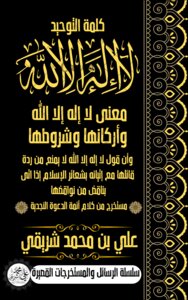
A Letter on Ruling By Man Made Laws Muhammad Ibn Ibrahim
رسالة تحكيم القوانين انجليزي
By: ali ibn mohammad cherigui
من طرف: علي بن محمد شريقي
Ruling by Other than what Allah Revealed
Allah (swt) says in the Qur’an:
“And whosoever does not rule by what Allah has revealed, such people are disbelievers (kafirun)” [TMQ 5:44]
“…such people are oppressors (zalimun)” [TMQ 5:45]
“…such people are deviators (fasiqun)” [TMQ 5:47]
Thus it is an obligation to judge/rule according to what Allah revealed, that is the Qur’an and the Sunnah
Although the above verse (5:44) was revealed regarding some from the People of the Book, the general meaning is taken and so it applies to everyone. The well-known principle of interpretation is that consideration is given to the generality of the expression, not the specific occasion of revelation (al-‘ibrah bi ‘umum al-lafz, la bi khusus al-sabab).
Al-Qurtubi relates from Ibn ‘Abbas and Mujahid that they said regarding 5:44, “According to this the ayah is general.” [Abu ‘Abdullah Muhammad ibn Ahmad al-Qurtubi, Tafsīr al-Qurṭubī: The General Judgments of the Qur’an and Clarification of What it Contains of the Sunnah and Āyahs of Discrimination, Vol. 6, translated by Ustadha Aisha Bewley, Diwan Press, 2021, p. 156]
Ibn Kathir comments in his tafsir:
‘Al-Bara’ bin ‘Azib, Hudhayfah bin Al-Yaman, Ibn ‘Abbas, Abu Mijlaz, Abu Raja’ Al-‘Utaridi, ‘Ikrimah, ‘Ubaydullah bin ‘Abdullah, Al-Hasan Al-Basri and others said that this ayah was revealed about the People of the Book. Al-Hasan Al-Basri added that this ayah also applies to us. ‘Abdur-Razzaq said that al-Thawri said that Mansur said that Ibrahim said that these ayat, “Were revealed about the Children of Israel, and Allah accepted them for this Ummah.” Ibn Jarir [al-Tabari] recorded this statement …
‘Abdur-Razzaq said, “Ma‘mar narrated to us that Tawus said that Ibn ‘Abbas was asked about Allah’s statement,
“And whosoever does not judge…”
He said, ‘It is an act of kufr.’ ” [Ibn Kathir, volume 3 pp. 187-188 of English translation]
Al-Tabari relates that al-Suddi interpreted 5:44 as: “Whoever does not rule by what I revealed, so he left it intentionally, and trangressed whilst knowing, then he is from the disbelievers.” [Tafsir al-Tabari, 6/257]
Al-Tabari also narrates that Ibn ‘Abbas (r) said, “Whoever rejects what Allah has revealed, will have committed Kufr, and whoever accepts what Allah has revealed but did not rule by it, is a Zalim (unjust) and a Fasiq (rebellious) and a sinner.”
Allah says:
“Do they then seek the judgement of (the days of) ignorance? And who is better in judgement than Allah for a people who have firm faith?” [TMQ 5:50]
Ibn Kathir comments in his tafsir:
Allah criticizes those who ignore His commandments which include every type of righteous good thing and prohibit every type of evil, but they refer instead to opinions, desires and customs that people themselves invented, all of which have no basis in His dīn. During the time of Jahiliyyah, the people used to abide by the misguidance and ignorance that they invented by sheer opinion and lusts. The Tatar (Mongols) abided by the law that they inherited from their king Genghis Khan who wrote Al-Yasiq for them. This book contains some rulings that were derived from various religions, such as Judaism, Christianity and Islam. Many of these rulings were derived from his own opinion and desires. Later on, these rulings became the followed law among his children, preferring them to the Law of the Book of Allah and the Sunnah of His Messenger ﷺ. Therefore, whoever does this, he is a disbeliever …
Allah said:
“Do they then seek the judgement of (the days of) ignorance?”
Meaning, they desire and want this and ignore Allah’s Judgement.
“And who is better in judgement than Allah for a people who have firm faith?”
Who is more just in decision than Allah for those who comprehend Allah’s Law, believe in Him, who are certain that Allah is the best among those who give decisions and that He is more merciful with His creation than the mother with her own child? Allah has perfect knowledge of everything, is able to do all things, and He is just in all matters. [Tafsir Ibn Kathir, vol. 3 p. 202 of the English translation]
Allah commands the following:
“If you differ in anything among yourselves, refer it to Allah and His Messenger, if you believe in Allah and the Last Day. That is better and more suitable for final determination.” [TMQ 4:59]
Ibn Kathir mentions regarding this verse in his tafsir:
‘Mujahid and several others among the Salaf said that the Ayah means, “(Refer) to the Book of Allah and the Sunnah of His Messenger.” This is a command from Allah that whatever areas the people dispute about, whether major or minor areas of the religion, they are required to refer to the Qur’an and Sunnah for judgment concerning these disputes…Allah’s statement:
“…if you believe in Allah and the Last Day”
indicates that those who do not refer to the Book and Sunnah for judgement in their disputes, are not believers in Allah or the Last Day.’
[Tafsir Ibn Kathir, vol. 2 pp. 498-499 of the English translation]


Share the book :
Book Review "A Letter on Ruling By Man Made Laws Muhammad Ibn Ibrahim رسالة تحكيم القوانين انجليزي"

Book Quotes "A Letter on Ruling By Man Made Laws Muhammad Ibn Ibrahim رسالة تحكيم القوانين انجليزي"

Other books like "A Letter on Ruling By Man Made Laws Muhammad Ibn Ibrahim رسالة تحكيم القوانين انجليزي"




Other books for "Ali Bin Muhammad Shariqi"


If there is a problem with the book, please report through one of the following links:
Report the book or by Contact us
E-books are complementary and supportive of paper books and never cancel it. With the click of a button, the e-book reaches anyone, anywhere in the world.
E-books may weaken your eyesight due to the glare of the screen. Support the book publisher by purchasing his original paper book. If you can access it and get it, do not hesitate to buy it.
Publish your book now for free