Effective Programming: More Than Writing Code

Account upgrade
The download is free, but we offer some paid services. Support us by subscribing
Delete ads and speed up browsing the library.
The download starts with the click of a button without waiting for the book to be ready.
No limits for download times.
You can upload unlimited books in the library.
Enable readers to download your books without waiting.
Delete ads on the books that you publish.
No problems with download links for your uploaded books.
Book Effective Programming More Than Writing Code
Copyright reserved
The book cannot be previewed or downloaded in order to preserve the copyright of the author and publishing house
Not available digitally or on paper through the Noor Library, it is for rating and review

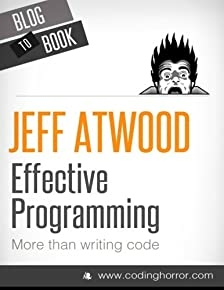

Effective Programming: More Than Writing Code
| Author: | Jeff Atwood |
| Category: | Programming Technology Without PWCT Code [Edit] |
| Language: | English |
| Publisher: | CreateSpace Independent Publishing Platform |
| ISBN: | 147830054 |
| Release Date: | 01 Jan 2012 |
| Rank: | 598,198 No 1 most popular |
| Short link: | Copy |
| More books like this book | |
Book Description
ABOUT THE BOOK Jeff Atwood began the Coding Horror blog in 2004, and is convinced that it changed his life. He needed a way to keep track of software development over time - whatever he was thinking about or working on. He researched subjects he found interesting, then documented his research with a public blog post, which he could easily find and refer to later. Over time, increasing numbers of blog visitors found the posts helpful, relevant and interesting. Now, approximately 100,000 readers visit the blog per day and nearly as many comment and interact on the site. Effective Programming: More Than Writing Code is your one-stop shop for all things programming. Jeff writes with humor and understanding, allowing for both seasoned programmers and newbies to appreciate the depth of his research. From such posts as "The Programmer's Bill of Rights" and "Why Cant Programmers... Program?" to "Working With the Chaos Monkey," this book introduces the importance of writing responsible code, the logistics involved, and how people should view it more as a lifestyle than a career. TABLE OF CONTENTS - Introduction - The Art of Getting Shit Done - Principles of Good Programming - Hiring Programmers the Right Way - Getting Your Team to Work Together - The Batcave: Effective Workspaces for Programmers - Designing With the User in Mind - Security Basics: Protecting Your Users' Data - Testing Your Code, So it Doesn't Suck More Than it Has To - Building, Managing and Benefiting from a Community - Marketing Weasels and How Not to Be One - Keeping Your Priorities Straight EXCERPT FROM THE BOOK As a software developer, you are your own worst enemy. The sooner you realize that, the better off you'll be.I know you have the best of intentions. We all do. We're software developers; we love writing code. It's what we do. We never met a problem we couldn't solve with some duct tape, a jury-rigged coat hanger and a pinch of code. But Wil Shipley argues that we should rein in our natural tendencies to write lots of code: The fundamental nature of coding is that our task, as programmers, is to recognize that every decision we make is a trade-off. To be a master programmer is to understand the nature of these trade-offs, and be conscious of them in everything we write.In coding, you have many dimensions in which you can rate code: Brevity of codeFeaturefulnessSpeed of executionTime spent codingRobustnessFlexibility Now, remember, these dimensions are all in opposition to one another. You can spend three days writing a routine which is really beautiful and fast, so you've gotten two of your dimensions up, but you've spent three days, so the "time spent coding" dimension is way down.So, when is this worth it? How do we make these decisions? The answer turns out to be very sane, very simple, and also the one nobody, ever, listens to: Start with brevity. Increase the other dimensions as required by testing. I couldn't agree more. I've given similar advice when I exhorted developers to Code Smaller. And I'm not talking about a reductio ad absurdum contest where we use up all the clever tricks in our books to make the code fit into less physical space. I'm talking about practical, sensible strategies to reduce the volume of code an individual programmer has to read to understand how a program works. Here's a trivial little example of what I'm talking about: if (s == String.Empty)if (s == "") It seems obvious to me that the latter case is... ...buy the book to read more!

Copyright reserved
The book cannot be previewed or downloaded in order to preserve the copyright of the author and publishing house
Not available digitally or on paper through the Noor Library, it is for rating and review
Share the book :
Book Review "Effective Programming: More Than Writing Code"

Book Quotes "Effective Programming: More Than Writing Code"

Other books like "Effective Programming: More Than Writing Code"





If there is a problem with the book, please report through one of the following links:
Report the book or by Contact us
E-books are complementary and supportive of paper books and never cancel it. With the click of a button, the e-book reaches anyone, anywhere in the world.
E-books may weaken your eyesight due to the glare of the screen. Support the book publisher by purchasing his original paper book. If you can access it and get it, do not hesitate to buy it.
Publish your book now for free