Die Wirtschaft : Das Geld, Die Maschine

Account upgrade
The download is free, but we offer some paid services. Support us by subscribing
Delete ads and speed up browsing the library.
The download starts with the click of a button without waiting for the book to be ready.
No limits for download times.
You can upload unlimited books in the library.
Enable readers to download your books without waiting.
Delete ads on the books that you publish.
No problems with download links for your uploaded books.
Download Book Die Wirtschaft Das Geld Die Maschine Pdf
This book is in public domain
This book was published with a Creative Commons license with a mention the author and source

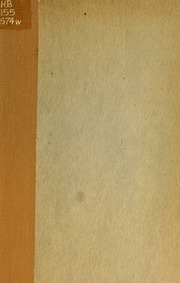

Die Wirtschaft : Das Geld, Die Maschine
| Author: | Oswald Spengler |
| Category: | Development Economics [Edit] |
| Language: | German |
| Publisher: | München : Beck |
| Release Date: | 01 Jan 1924 |
| Pages: | 62 |
| File Size: | 4.03 MB |
| Extension: | |
| Creation Date: | 19 May 2014 |
| Rank: | 190,637 No 1 most popular |
| Short link: | Copy |
| More books like this book | |
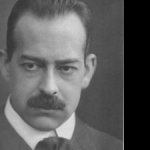
Oswald Spengler
The Author Book Die Wirtschaft : Das Geld, Die Maschine and the author of 8 another books.
Oswald Spengler was born in 1880 in Blankenburg (then in the Duchy of Brunswick, German Empire) at the foot of the Harz mountains, the eldest of four children, and the only boy. His family was conservative German of the petite bourgeoisie. His father, originally a mining technician, who came from a long line of mineworkers, was a post office bureaucrat. His childhood home was emotionally reserved, Oswald Spengler was born in 1880 in Blankenburg (then in the Duchy of Brunswick, German Empire) at the foot of the Harz mountains, the eldest of four children, and the only boy. His family was conservative German of the petite bourgeoisie. His father, originally a mining technician, who came from a long line of mineworkers, was a post office bureaucrat. His childhood home was emotionally reserved, and the young Spengler turned to books and the great cultural personalities for succor. He had imperfect health, and suffered throughout his life from migraine headaches and from an anxiety complex.
At the age of ten, his family moved to the university city of Halle. Here Spengler received a classical education at the local Gymnasium (academically oriented secondary school), studying Greek, Latin, mathematics and natural sciences. Here, too, he developed his affinity for the arts—especially poetry, drama, and music—and came under the influence of the ideas of Goethe and Nietzsche. He even experimented with a few artistic creations, some of which still survive.
After his father's death in 1901 Spengler attended several universities (Munich, Berlin, and Halle) as a private scholar, taking courses in a wide range of subjects: history, philosophy, mathematics, natural science, literature, the classics, music, and fine arts. His private studies were undirected. In 1903, he failed his doctoral thesis on Heraclitus because of insufficient references, which effectively ended his chances of an academic career. In 1904 he received his Ph.D., and in 1905 suffered a nervous breakdown.
Scholars[which?] remark that his life seemed rather uneventful. He briefly served as a teacher in Saarbrücken and then in Düsseldorf. From 1908 to 1911 he worked at a grammar school (Realgymnasium) in Hamburg, where he taught science, German history, and mathematics.
In 1911, following his mother's death, he moved to Munich, where he would live until his death in 1936. He lived as a cloistered scholar, supported by his modest inheritance. Spengler survived on very limited means and was marked by loneliness. He owned no books, and took jobs as a tutor or wrote for magazines to earn additional income.
He began work on the first volume of Decline of the West intending at first to focus on Germany within Europe, but the Agadir Crisis affected him deeply, and he widened the scope of his study. Spengler was inspired by Otto Seeck's work The Decline of Antiquity in naming his own effort. The book was completed in 1914, but publishing was delayed by World War I. Due to a congenital heart problem, he was not called up for military service. During the war, however, his inheritance was largely useless because it was invested overseas; thus Spengler lived in genuine poverty for this period.
Book Description
"Sonderdruck aus 'Der Untergang des Abendlandes' II. Band."
Includes bibliographical references


Share the book :
Book Review "Die Wirtschaft : Das Geld, Die Maschine"

Book Quotes "Die Wirtschaft : Das Geld, Die Maschine"

Other books like "Die Wirtschaft : Das Geld, Die Maschine"









Other books for "Oswald Spengler"

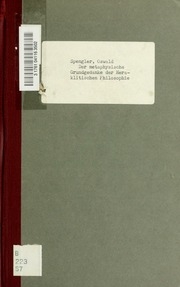
If there is a problem with the book, please report through one of the following links:
Report the book or by Contact us
E-books are complementary and supportive of paper books and never cancel it. With the click of a button, the e-book reaches anyone, anywhere in the world.
E-books may weaken your eyesight due to the glare of the screen. Support the book publisher by purchasing his original paper book. If you can access it and get it, do not hesitate to buy it.
Publish your book now for free