Cracking Codes : The Rosetta Stone And Decipherment

Account upgrade
The download is free, but we offer some paid services. Support us by subscribing
Delete ads and speed up browsing the library.
The download starts with the click of a button without waiting for the book to be ready.
No limits for download times.
You can upload unlimited books in the library.
Enable readers to download your books without waiting.
Delete ads on the books that you publish.
No problems with download links for your uploaded books.
Download Book Cracking Codes The Rosetta Stone And Decipherment Pdf
This book is in public domain
This book was published with a Creative Commons license with a mention the author and source

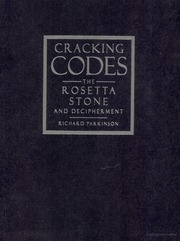

Cracking Codes : The Rosetta Stone And Decipherment
| Author: | R. B Parkinson |
| Category: | Ancient Egyptian Civilization And The Pharaohs [Edit] |
| Language: | English |
| Publisher: | Berkeley : University of California Press |
| Release Date: | 01 Jan 1999 |
| Pages: | 225 |
| File Size: | 15.38 MB |
| Extension: | |
| Creation Date: | 29 Nov 2014 |
| Rank: | 306,865 No 1 most popular |
| Short link: | Copy |
| More books like this book | |

R. B Parkinson
The Author Book Cracking Codes : The Rosetta Stone And Decipherment .
Parkinson, R. B
Book Description
Napoleon's troops discovered a granitoid slab in the village of Rosetta in the western Delta in 1799. The Rosetta Stone was to become one of the most famous Egyptian antiquities in the world as well as an instantly recognizable icon of script and decipherment. In this exciting, beautifully illustrated work, Richard Parkinson tells the story of the Stone's discovery and the socalled battle of the decipherers that it inspired. Published to accompany a major exhibition at the British Museum celebrating the bicentenary of the Stone's discovery, and including a selective catalog of the exhibits, this book also examines the wider issues of script and writing in ancient Egypt and beyond. The Rosetta Stone is a fragment of a stela inscribed with a priestly decree in honor of Ptolemy V. The main significance of the text lies not in its content, however, but in the fact that it is written in three scripts—hieroglyphic, demotic, and ancient Greek. Early Orientalists recognized immediately the potential of the Stone for the decipherment of Egyptian hieroglyphs. Thomas Young made great advances, especially with the demotic text, but it was JeanFrançois Champollion who made the final breakthrough in 1822. In so doing he cracked much more than two Egyptian scripts He opened up Egyptian culture as a whole to historians. Among the subjects discussed in Cracking Codes are the relationship between hieroglyphs and art, the social prestige of literacy, and the power of writing and its practical aspects scribal equipment and training. A brief description of other decipherments is also given, drawing on examples such as Linear B and Meroitic—a language which remains to be read. A selection of the History Book Club, the BookoftheMonth Club, and the Quality Paperback Book Club
Includes bibliographical references (p. 202) and index


Share the book :
Book Review "Cracking Codes : The Rosetta Stone And Decipherment"

Book Quotes "Cracking Codes : The Rosetta Stone And Decipherment"

Other books like "Cracking Codes : The Rosetta Stone And Decipherment"







If there is a problem with the book, please report through one of the following links:
Report the book or by Contact us
E-books are complementary and supportive of paper books and never cancel it. With the click of a button, the e-book reaches anyone, anywhere in the world.
E-books may weaken your eyesight due to the glare of the screen. Support the book publisher by purchasing his original paper book. If you can access it and get it, do not hesitate to buy it.
Publish your book now for free