CASE FILES™ Pharmacology - Third Edition

Account upgrade
The download is free, but we offer some paid services. Support us by subscribing
Delete ads and speed up browsing the library.
The download starts with the click of a button without waiting for the book to be ready.
No limits for download times.
You can upload unlimited books in the library.
Enable readers to download your books without waiting.
Delete ads on the books that you publish.
No problems with download links for your uploaded books.
Download Book Case Files Pharmacology Third Edition Pdf
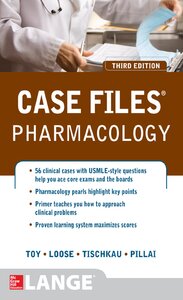

CASE FILES™ Pharmacology - Third Edition
| Author: | Eugene C. Toy - David S. Loose - Shelley A. Tischkau - Anush S. Pillai. |
| Category: | Medical Sciences [Edit] |
| Language: | English |
| Publisher: | McGraw-Hill Education - LANGE |
| ISBN: | 9780071790246 |
| Release Date: | 01 Jan 2014 |
| Pages: | 464 |
| File Size: | 3.2 MB |
| Extension: | |
| Creation Date: | 20 Jul 2013 |
| Rank: | 66,309 No 1 most popular |
| Short link: | Copy |
| More books like this book | |

Mohamed Irhuma
Professor
The Publisher and not the author Book CASE FILES™ Pharmacology - Third Edition .
As a Professor in Clinical Pharmacology, an academic researcher, and a physician, my professional journey has uniquely positioned me at the nexus of scientific rigour and holistic well-being. My work transcends conventional medical boundaries, delving into the philosophical underpinnings of Islamic thought, particularly as they relate to human health and spiritual [Imaan] flourishing. My research often explores how the sacred Islamic principles, such as those found in the rich Prophetic Sunnah, can inform contemporary medical ethics and practice. I aim to offer a nuanced perspective on healing that encompasses both body and soul [Imaan], acknowledging the Sunnah's role as a "divinely preserved legacy" that "elucidates the Qur’an’s commands" and guides a complete way of life. This interdisciplinary approach, deeply rooted in both empirical science and the true rich heritage of Islamic philosophy, underpins my writing, bridging the gap between faith [ISLAM] and evidence-based knowledge.
Book Description
Often, the medical student will cringe at the “drudgery” of the basic science courses and see little connection between a field such as pharmacology and clinical problems. Clinicians, however, often wish they knew more about the basic sciences, because it is through the science that we can begin to understand the complexities of the human body and thus have rational methods of diagnosis and treatment.
Mastering the knowledge in a discipline such as pharmacology is a formidable task. It is even more difficult to retain this information and to recall it when the clinical setting is encountered. To accomplish this synthesis, pharmacology is optimally taught in the context of medical situations, and this is reinforced later during the clinical rotations. The gulf between the basic sciences and the patient arena is wide.
Perhaps one way to bridge this gulf is with carefully constructed clinical cases that ask basic science-oriented questions. In an attempt to achieve this goal, we have designed a collection of patient cases to teach pharmacology-related points. More importantly, the explanations for these cases emphasize the underlying mechanisms and relate the clinical setting to the basic science data. The principles are explored rather than overemphasizing rote memorization.
This book is organized for versatility: to allow the student “in a rush” to go quickly through the scenarios and check the corresponding answers and to provide more detailed information for the student who wants thought-provoking explanations.
The answers are arranged from simple to complex: a summary of the pertinent points, the bare answers, a clinical correlation, an approach to the pharmacology topic, a comprehension test at the end for reinforcement or emphasis, and a list of references for further reading. The clinical cases are arranged by system to better reflect the organization within the basic science. Finally, to encourage thinking about mechanisms and relationships, we used open-ended questions in the clinical cases. Nevertheless, several multiple-choice questions are included at the end of each scenario to reinforce concepts or introduce related topics.
HOW TO GET THE MOST OUT OF THIS BOOK
Each case is designed to introduce a clinically related issue and includes open-ended questions usually asking a basic science question, but at times, to break up the monotony, there will be a clinical question. The answers are organized into four different parts:
Part I
1. Summary
2. A straightforward answer is given for each open-ended question.
3. Clinical Correlation—A discussion of the relevant points relating the basic science to the clinical manifestations, and perhaps introducing the student to issues such as diagnosis and treatment.
Part II
An approach to the basic science concept consisting of three parts:
1. Objectives—A listing of the two to four main knowledge objectives that are critical for understanding the underlying pharmacology to answer the question and relate to the clinical situation.
2. Definitions of basic terminology.
3. Discussion of the specifi c class of agents.
Part III
Comprehension Questions—Each case includes several multiple-choice questions that reinforce the material or introduces new and related concepts. Questions about the material not found in the text are explained in the answers.
Part IV
Pharmacology Pearls—A listing of several important points, many clinically relevant, reiterated as a summation.


Share the book :

Book Quotes "CASE FILES™ Pharmacology - Third Edition"

Other books like "CASE FILES™ Pharmacology - Third Edition"







If there is a problem with the book, please report through one of the following links:
Report the book or by Contact us
E-books are complementary and supportive of paper books and never cancel it. With the click of a button, the e-book reaches anyone, anywhere in the world.
E-books may weaken your eyesight due to the glare of the screen. Support the book publisher by purchasing his original paper book. If you can access it and get it, do not hesitate to buy it.
Publish your book now for free