القول الأبلغ على القواعد الأربع - Hausa

Account upgrade
The download is free, but we offer some paid services. Support us by subscribing
Delete ads and speed up browsing the library.
The download starts with the click of a button without waiting for the book to be ready.
No limits for download times.
You can upload unlimited books in the library.
Enable readers to download your books without waiting.
Delete ads on the books that you publish.
No problems with download links for your uploaded books.
Download Book القول الأبلغ على القواعد الأربع Hausa Pdf
The publisher is the author
Previewing the book or downloading it for personal use only and any other powers should be obtained from the author of the book publisher



القول الأبلغ على القواعد الأربع - Hausa
| Author: | Imam Muhammad |
| Category: | Monotheism [Edit] |
| Language: | English |
| Pages: | 28 |
| File Size: | 5.71 MB |
| Extension: | |
| Creation Date: | 18 Aug 2025 |
| Rank: | 692,726 No 1 most popular |
| Short link: | Copy |
| More books like this book | |

Imam Muhammad
The Publisher and the author
Book القول الأبلغ على القواعد الأربع - Hausa .
Author — Hâfiz — Imām — Tutor — Qāri'
Book Description
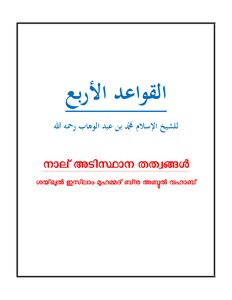
The four foundations of Shirk, as described by Muhammad ibn Abd al-Wahhab, elucidate the idea of associating partners with Allah and underscore its perils. These principles stress that merely recognizing Allah as the creator is insufficient, and that attempting to draw closer to Allah through intermediaries is forbidden. They also clarify that all types of Shirk, including the worship of anything besides Allah, are prohibited, and that modern forms of Shirk are even more severe than those in the past.
Here’s a more detailed overview:
1. Recognition of Allah as the creator is not enough: The first principle asserts that simply believing in Allah as the creator does not equate to true faith, as even those who engage in Shirk may acknowledge His role.
2. Prohibition against seeking closeness to Allah through intermediaries: The second principle forbids seeking nearness to Allah via intermediaries such as prophets, angels, or saints, emphasizing that true Tauhīd (oneness of Allah) requires direct worship and supplication to Allah alone.
3. All forms of Shirk are prohibited: This foundation stresses that any worship directed towards anything other than Allah constitutes Shirk and is thus forbidden.
4. Modern polytheism is more severe than historical forms: The fourth foundation indicates that contemporary expressions of Shirk, often camouflaged in various forms, pose a greater threat than the overt polytheism of the past, as they can be more subtle and harder to recognize.
Grasping these four foundations is essential for Muslims to avoid falling into the trap of Shirk and to uphold a pure and sincere form of Tauhīd.


Share the book :
Book Review "القول الأبلغ على القواعد الأربع - Hausa"

Book Quotes "القول الأبلغ على القواعد الأربع - Hausa"

Other books like "القول الأبلغ على القواعد الأربع - Hausa"




Other books for "Imam Muhammad"


If there is a problem with the book, please report through one of the following links:
Report the book or by Contact us
E-books are complementary and supportive of paper books and never cancel it. With the click of a button, the e-book reaches anyone, anywhere in the world.
E-books may weaken your eyesight due to the glare of the screen. Support the book publisher by purchasing his original paper book. If you can access it and get it, do not hesitate to buy it.
Publish your book now for free