Prayers For Forgiveness

Account upgrade
The download is free, but we offer some paid services. Support us by subscribing
Delete ads and speed up browsing the library.
The download starts with the click of a button without waiting for the book to be ready.
No limits for download times.
You can upload unlimited books in the library.
Enable readers to download your books without waiting.
Delete ads on the books that you publish.
No problems with download links for your uploaded books.
Book Prayers For Forgiveness
Copyright reserved
The book cannot be previewed or downloaded in order to preserve the copyright of the author and publishing house
Not available digitally or on paper through the Noor Library, it is for rating and review



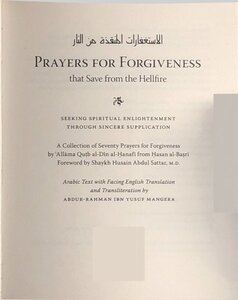
Prayers For Forgiveness
| Author: | AlHassan AlBasri , Abdur-Rahman Ibn Yusuf , Al-Hasan Al-Basri |
| Category: | Reading Rules For The Arabic Language [Edit] |
| Language: | English |
| Publisher: | White Thread Press (first published April 2004) |
| Release Date: | 01 Jan 2004 |
| Pages: | 92 |
| Rank: | 425,554 No 1 most popular |
| Short link: | Copy |
| More books like this book | |
Book Description
The act of seeking forgiveness is what gives us the opening we need after feeling overwhelmed by the burden of sin. Forgiveness means a way out, a second chance, a feeling of hope with which to turn a new page in life. It is through the seeking of forgiveness that we begin to understand that there is no reason whatsoever to despair of the mercy of God. Islam encourages us The act of seeking forgiveness is what gives us the opening we need after feeling overwhelmed by the burden of sin. Forgiveness means a way out, a second chance, a feeling of hope with which to turn a new page in life. It is through the seeking of forgiveness that we begin to understand that there is no reason whatsoever to despair of the mercy of God. Islam encourages us to not run away in fear of Allah but rather to turn toward God the same way a baby would run into its mother's lap. So lovingly does God, Most High, address His sinful servants: "Say (to humanity, O Muhammad): O My servantsthose (of you) who have committed (sins in great) excess against their own soulsnever despair of the mercy of Allah! For, indeed, Allah forgives sins, one and all. Indeed, it is He who is the All-Forgiving, the Mercy-Giving. So turn in penitence to your Lord. And submit yourselves to Him." (The Qur'an 39:53-54)
This collection of seventy prayers for forgiveness [istighfarat] is attributed to one of the greatest spiritual luminaries of the past, Hasan al-Basri, and it has been presented here to offer a way for us to navigate through the complications and pitfalls of this life. Set out in Arabic script, with adjoining translation in English, this edition also includes transliteration of the prayers to facilitate reading for those who are not so well-versed in Arabic.

Copyright reserved
The book cannot be previewed or downloaded in order to preserve the copyright of the author and publishing house
Not available digitally or on paper through the Noor Library, it is for rating and review
Share the book :
Book Review "Prayers For Forgiveness"

Book Quotes "Prayers For Forgiveness"

Other books like "Prayers For Forgiveness"







If there is a problem with the book, please report through one of the following links:
Report the book or by Contact us
E-books are complementary and supportive of paper books and never cancel it. With the click of a button, the e-book reaches anyone, anywhere in the world.
E-books may weaken your eyesight due to the glare of the screen. Support the book publisher by purchasing his original paper book. If you can access it and get it, do not hesitate to buy it.
Publish your book now for free