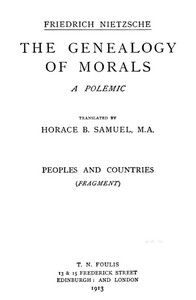
On The Genealogy Of Morals By Nietzsche

Account upgrade
The download is free, but we offer some paid services. Support us by subscribing
Delete ads and speed up browsing the library.
The download starts with the click of a button without waiting for the book to be ready.
No limits for download times.
You can upload unlimited books in the library.
Enable readers to download your books without waiting.
Delete ads on the books that you publish.
No problems with download links for your uploaded books.
Book On The Genealogy Of Morals By Nietzsche
Copyright reserved
The book cannot be previewed or downloaded in order to preserve the copyright of the author and publishing house
Not available digitally or on paper through the Noor Library, it is for rating and review



On The Genealogy Of Morals By Nietzsche
| Author: | Friedrich Nietzsche (Friedrich Nietzs ... |
| Category: | Islamic Ethics And Ethics [Edit] |
| Language: | English |
| Publisher: | Evergreen Review, Inc. |
| Release Date: | 01 Jan 2008 |
| Rank: | 500,416 No 1 most popular |
| Short link: | Copy |
| More books like this book | |
Book Description
From Preface: "We don't know ourselves, we knowledgeable people-we are personally ignorant about ourselves. And there's good reason for that. We've never tried to find out who we are. How could it ever happen that one day we'd discover our own selves? With justice it's been said that "where your treasure is, there shall your heart be also." Our treasure lies where the beehives of our knowledge stand. We are always busy with our knowledge, as if we were born winged creatures-collectors of intellectual honey. In our hearts we are basically concerned with only one thing, to "bring something home." As far as the rest of life is concerned, what people call "experience"-which of us is serious enough for that? Who has enough time? In these matters, I fear, we've been "missing the point." Our hearts have not even been engaged-nor, for that matter, have our ears! We've been much more like someone divinely distracted and self-absorbed into whose ear the clock has just pealed the twelve strokes of noon with all its force and who all at once wakes up and asks himself "What exactly did that clock strike?"-so we rub ourselves behind the ears afterwards and ask, totally surprised and embarrassed "What have we really just experienced? And more: "Who are we really?" Then, as I've mentioned, we count-after the fact-all the twelve trembling strokes of the clock of our experience, our lives, our being-alas! in the process we keep losing the count. So we remain necessarily strangers to ourselves, we do not understand ourselves, we have to keep ourselves confused. For us this law holds for all eternity: "Each man is furthest from himself." Where we ourselves are concerned, we are not "knowledgeable people." My thoughts over the origin of our moral prejudices-for this polemical tract is concerned about that origin-had their first brief and provisional expression in that collection of aphorisms which carried the title Human."

Copyright reserved
The book cannot be previewed or downloaded in order to preserve the copyright of the author and publishing house
Not available digitally or on paper through the Noor Library, it is for rating and review
Share the book :
Book Review "On The Genealogy Of Morals By Nietzsche"

Book Quotes "On The Genealogy Of Morals By Nietzsche"

Other books like "On The Genealogy Of Morals By Nietzsche"













Other books for "Friedrich Nietzsche (Friedrich Nietzs ..."
If there is a problem with the book, please report through one of the following links:
Report the book or by Contact us
E-books are complementary and supportive of paper books and never cancel it. With the click of a button, the e-book reaches anyone, anywhere in the world.
E-books may weaken your eyesight due to the glare of the screen. Support the book publisher by purchasing his original paper book. If you can access it and get it, do not hesitate to buy it.
Publish your book now for free