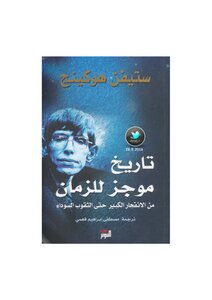
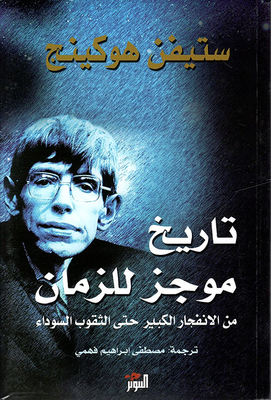
A Brief History Of Time

Account upgrade
The download is free, but we offer some paid services. Support us by subscribing
Delete ads and speed up browsing the library.
The download starts with the click of a button without waiting for the book to be ready.
No limits for download times.
You can upload unlimited books in the library.
Enable readers to download your books without waiting.
Delete ads on the books that you publish.
No problems with download links for your uploaded books.
Book A Brief History Of Time
Copyright reserved
The book cannot be previewed or downloaded in order to preserve the copyright of the author and publishing house
Not available digitally or on paper through the Noor Library, it is for rating and review


A Brief History Of Time
| Author: | Stephen Hawking |
| Category: | English [Edit] |
| Language: | English |
| Publisher: | English books |
| Release Date: | 01 Jan 2011 |
| Pages: | 272 |
| Rank: | 255,777 No 1 most popular |
| Short link: | Copy |
| More books like this book | |

Stephen Hawking
The Author Book A Brief History Of Time and the author of 3 another books.
Stephen William Hawking was born on 8 January 1942 in Oxford, England. His parents' house was in north London, but during the second world war Oxford was considered a safer place to have babies. When he was eight, his family moved to St Albans, a town about 20 miles north of London. At eleven Stephen went to St Albans School, and then on to University College, Oxford, his father's old college. Ste Stephen William Hawking was born on 8 January 1942 in Oxford, England. His parents' house was in north London, but during the second world war Oxford was considered a safer place to have babies. When he was eight, his family moved to St Albans, a town about 20 miles north of London. At eleven Stephen went to St Albans School, and then on to University College, Oxford, his father's old college. Stephen wanted to do Mathematics, although his father would have preferred medicine. Mathematics was not available at University College, so he did Physics instead. After three years and not very much work he was awarded a first class honours degree in Natural Science.
Stephen then went on to Cambridge to do research in Cosmology, there being no-one working in that area in Oxford at the time. His supervisor was Denis Sciama, although he had hoped to get Fred Hoyle who was working in Cambridge. After gaining his Ph.D. he became first a Research Fellow, and later on a Professorial Fellow at Gonville and Caius College. After leaving the Institute of Astronomy in 1973 Stephen came to the Department of Applied Mathematics and Theoretical Physics, and since 1979 has held the post of Lucasian Professor of Mathematics. The chair was founded in 1663 with money left in the will of the Reverend Henry Lucas, who had been the Member of Parliament for the University. It was first held by Isaac Barrow, and then in 1669 by Isaac Newton.
Stephen Hawking worked on the basic laws which govern the universe. With Roger Penrose he showed that Einstein's General Theory of Relativity implied space and time would have a beginning in the Big Bang and an end in black holes. These results indicated it was necessary to unify General Relativity with Quantum Theory, the other great Scientific development of the first half of the 20th Century. One consequence of such a unification that he discovered was that black holes should not be completely black, but should emit radiation and eventually evaporate and disappear. Another conjecture is that the universe has no edge or boundary in imaginary time. This would imply that the way the universe began was completely determined by the laws of science.
His many publications include The Large Scale Structure of Spacetime with G.F.R. Ellis, General Relativity: An Einstein Centenary Survey, with W. Israel, and 300 Years of Gravity, with W. Israel. Stephen Hawking has three popular books published; his best seller A Brief History of Time, Black Holes and Baby Universes and Other Essays and most recently in 2001, The Universe in a Nutshell.
Professor Hawking received twelve honorary degrees, was awarded the CBE in 1982, and was made a Companion of Honour in 1989. He was the recipient of many awards, medals and prizes and is a Fellow of The Royal Society and a Member of the US National Academy of Sciences.
Book Description
Was there a beginning of time? Could time run backwards? Is the universe infinite or does it have boundaries?
These are just some of the questions considered in the internationally acclaimed masterpiece by the world renowned physicist - generally considered to have been one of the world's greatest thinkers. It begins by reviewing the great theories of the cosmos from Newton to Einstein, before delving into the secrets which still lie at the heart of space and time, from the Big Bang to black holes, via spiral galaxies and strong theory. To this day A Brief History of Time remains a staple of the scientific canon, and its succinct and clear language continues to introduce millions to the universe and its wonders.
This new edition includes recent updates from Stephen Hawking with his latest thoughts about the No Boundary Proposal and offers new information about dark energy, the information paradox, eternal inflation, the microwave background radiation observations, and the discovery of gravitational waves.
Copyright reserved
The book cannot be previewed or downloaded in order to preserve the copyright of the author and publishing house
Not available digitally or on paper through the Noor Library, it is for rating and review
Share the book :
Book Review "A Brief History Of Time"

Book Quotes "A Brief History Of Time"

Other books like "A Brief History Of Time"
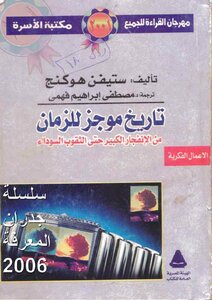

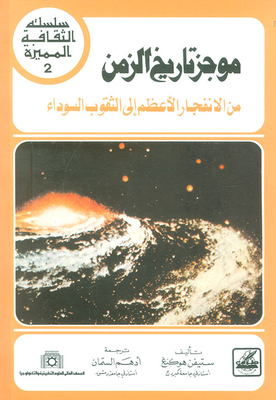



Other books for "Stephen Hawking"
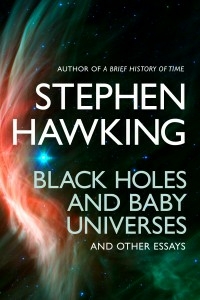


If there is a problem with the book, please report through one of the following links:
Report the book or by Contact us
E-books are complementary and supportive of paper books and never cancel it. With the click of a button, the e-book reaches anyone, anywhere in the world.
E-books may weaken your eyesight due to the glare of the screen. Support the book publisher by purchasing his original paper book. If you can access it and get it, do not hesitate to buy it.
Publish your book now for free