العالم كما اراه

ترقية حسابك
التحميل مجاناً لكن نقدم بعض الخدمات المدفوعة ادعمنا بالإشتراك فيها
حذف الإعلانات وتسريع تصفح المكتبة.
يبدأ التحميل بضغطة زر دون انتظار تجهيز الكتاب.
لا حدود لمرات التحميل.
يمكنك رفع كتب بلا حدود بالمكتبة.
تمكين القراء من تحميل كتبك دون إنتظار.
حذف الاعلانات على الكتب التي تنشرها.
لا مشاكل في روابط التحميل لكتبك المرفوعة.
كتاب العالم كما اراه
حقوق النشر محفوظة
لا يمكن قراءة الكتاب أو تحميله حفاظاً على حقوق نشر المؤلف و دار النشر
غير متوفر رقمياً أو ورقياً من خلال مكتبة نور، متروك للتقييم والمراجعة

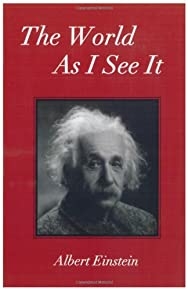

العالم كما اراه
| مؤلف: | ألبرت أينشتاين |
| قسم: | قسم غير محدد [تعديل] |
| اللغة: | الإنجليزية |
| الناشر: | Open Road / Philosophical Library |
| ردمك ISBN: | 1453204989 |
| تاريخ الإصدار: | 01 يناير 2011 |
| ترتيب الشهرة: | 143,902 رقم 1 هو الأشهر ! |
| رابط مختصر: | نسخ |
| المزيد من الكتب مثل هذا الكتاب | |

ألبرت أينشتاين
المؤلف كتاب العالم كما اراه .
In 1879, Albert Einstein was born in Ulm, Germany. He completed his Ph.D. at the University of Zurich by 1909. His 1905 paper explaining the photoelectric effect, the basis of electronics, earned him the Nobel Prize in 1921. His first paper on Special Relativity Theory, also published in 1905, changed the world. After the rise of the Nazi party, Einstein made Princeton his permanent home, becoming In 1879, Albert Einstein was born in Ulm, Germany. He completed his Ph.D. at the University of Zurich by 1909. His 1905 paper explaining the photoelectric effect, the basis of electronics, earned him the Nobel Prize in 1921. His first paper on Special Relativity Theory, also published in 1905, changed the world. After the rise of the Nazi party, Einstein made Princeton his permanent home, becoming a U.S. citizen in 1940. Einstein, a pacifist during World War I, stayed a firm proponent of social justice and responsibility. He chaired the Emergency Committee of Atomic Scientists, which organized to alert the public to the dangers of atomic warfare.
At a symposium, he advised: "In their struggle for the ethical good, teachers of religion must have the stature to give up the doctrine of a personal God, that is, give up that source of fear and hope which in the past placed such vast power in the hands of priests. In their labors they will have to avail themselves of those forces which are capable of cultivating the Good, the True, and the Beautiful in humanity itself. This is, to be sure a difficult but an incomparably worthy task . . . " ("Science, Philosophy and Religion, A Symposium," published by the Conference on Science, Philosophy and Religion in their Relation to the Democratic Way of Life, Inc., New York, 1941). In a letter to philosopher Eric Gutkind, dated Jan. 3, 1954, Einstein stated: "The word god is for me nothing than the expression and product of human weaknesses, the Bible a collection of honorable, but still primitive legends which are nevertheless pretty childish. No interpretation no matter how subtle can (for me) change this," (The Guardian, "Childish superstition: Einstein's letter makes view of religion relatively clear," by James Randerson, May 13, 2008). D. 1955.
While best known for his mass–energy equivalence formula E = mc2 (which has been dubbed "the world's most famous equation"), he received the 1921 Nobel Prize in Physics "for his services to theoretical physics, and especially for his discovery of the law of the photoelectric effect". The latter was pivotal in establishing quantum theory.
Einstein thought that Newtonion mechanics was no longer enough to reconcile the laws of classical mechanics with the laws of the electromagnetic field. This led to the development of his special theory of relativity. He realized, however, that the principle of relativity could also be extended to gravitational fields, and with his subsequent theory of gravitation in 1916, he published a paper on the general theory of relativity. He continued to deal with problems of statistical mechanics and quantum theory, which led to his explanations of particle theory and the motion of molecules. He also investigated the thermal properties of light which laid the foundation of the photon theory of light.
He was visiting the United States when Adolf Hitler came to power in 1933 and did not go back to Germany. On the eve of World War II, he endorsed a letter to President Franklin D. Roosevelt alerting him to the potential development of "extremely powerful bombs of a new type" and recommending that the U.S. begin similar research. This eventually led to what would become the Manhattan Project. Einstein supported defending the Allied forces, but largely denounced the idea of using the newly discovered nuclear fission as a weapon. Later, with Bertrand Russell, Einstein signed the Russell–Einstein Manifesto, which highlighted the danger of nuclear weapons. Einstein was affiliated with the Institute for Advanced Study in Princeton, New Jersey, until his death in 1955.
His great intellectual achievements and originality have made the word "Einstein" synonymous with genius.
More:
وصف الكتاب
A fascinating collection of Einstein’s observations about life, religion, nationalism, and a host of personal topics that engaged the genius’s intellect In the aftermath of the First World War, Einstein writes about his hopes for the League of Nations, his feelings as a German citizen about the growing anti-Semitism and nationalism of his country, and his myriad opinions about the current affairs of his day. In addition to these political perspectives, The World As I See It reveals the idealistic, spiritual, and witty side of this great intellectual as he approaches topics including “Good and Evil,” “Religion and Science,” “Active Pacifism,” “Christianity and Judaism,” and “Minorities.” Including letters, speeches, articles, and essays written before 1935, this collection offers a complete portrait of Einstein as a humanitarian and as a human being trying to make sense of the changing world around him. This authorized Philosophical Library ebook features a new introduction by Neil Berger and an illustrated biography of Albert Einstein, which includes rare photos and never-before-seen documents from the Albert Einstein Archives at the Hebrew University of Jerusalem. “Without the sense of fellowship with men of like mind, of preoccupation with the objective, the eternally unattainable in the field of art and scientific research, life would have seemed to me empty.” —Albert Einstein, Forum and Century “Preceding generations have presented us, in a highly developed science and mechanical knowledge, with a most valuable gift which carries with it possibilities of making our life free and beautiful such as no previous generation has enjoyed. But this gift also brings with it dangers to our existence as great as any that have ever threatened it.” —Albert Einstein, Address to the Students’ Disarmament Meeting Albert Einstein (1879–1955) was born in Germany and became an American citizen in 1940. A world-famous theoretical physicist, he as awarded the 1921 Nobel Prize for Physics and is renowned for his Theory of Relativity. In addition to his scientific work, Einstein was an influential humanist who spoke widely about politics, ethics, and social causes. After leaving Europe, Einstein taught at Princeton University. His theories were instrumental in shaping the atomic age. Neil Berger, an associate professor emeritus of mathematics, taught at the University of Illinois at Chicago in the Mathematics, Statistics, and Computer Science department from 1968 until his retirement in 2001. He was the recipient of the first Monroe H. Martin Prize (1975), which is now awarded by the University of Maryland every five years for a singly authored outstanding applied mathematics research paper. He has published numerous papers and reviews in his fields of expertise, which include elasticity, tensor analysis, scattering theory, and fluid mechanics.

حقوق النشر محفوظة
لا يمكن قراءة الكتاب أو تحميله حفاظاً على حقوق نشر المؤلف و دار النشر
غير متوفر رقمياً أو ورقياً من خلال مكتبة نور، متروك للتقييم والمراجعة
شارك الكتاب :
مراجعة كتاب "العالم كما اراه"

اقتباسات كتاب "العالم كما اراه"

كتب أخرى مثل "العالم كما اراه"





فى حالة وجود مشكلة بالكتاب الرجاء الإبلاغ من خلال أحد الروابط التالية:
بلّغ عن الكتاب أو من خلال التواصل معنا
الكتب الإلكترونية هي مكملة وداعمة للكتب الورقية ولا تلغيه أبداً بضغطة زر يصل الكتاب الإلكتروني لأي شخص بأي مكان بالعالم.
قد يضعف نظرك بسبب توهج الشاشة، أدعم ناشر الكتاب بشراءك لكتابه الورقي الأصلي إذا تمكنت من الوصول له والحصول عليه فلا تتردد بشراءه.
أنشر كتابك الآن مجانا