Is the Koran True or False

ترقية حسابك
التحميل مجاناً لكن نقدم بعض الخدمات المدفوعة ادعمنا بالإشتراك فيها
حذف الإعلانات وتسريع تصفح المكتبة.
يبدأ التحميل بضغطة زر دون انتظار تجهيز الكتاب.
لا حدود لمرات التحميل.
يمكنك رفع كتب بلا حدود بالمكتبة.
تمكين القراء من تحميل كتبك دون إنتظار.
حذف الاعلانات على الكتب التي تنشرها.
لا مشاكل في روابط التحميل لكتبك المرفوعة.
تحميل كتاب Is The Koran True Or False Pdf
الناشر بالمكتبة هو المؤلف
معاينة الكتاب أو تحميله للإستخدام الشخصي فقط وأي صلاحيات أخرى يجب أخذ إذن من المؤلف ناشر الكتاب

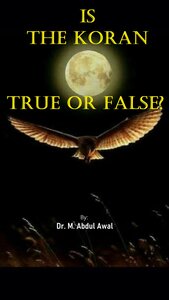

Is The Koran True Or False
| مؤلف: | Dr. Abdul Awal |
| قسم: | علوم القرآن الكريم [تعديل] |
| اللغة: | الإنجليزية |
| الصفحات: | 588 |
| حجم الملف: | 17.02 ميجا بايت |
| نوع الملف: | |
| تاريخ الإنشاء: | 16 يناير 2024 |
| ترتيب الشهرة: | 471,189 رقم 1 هو الأشهر ! |
| رابط مختصر: | نسخ |
| المزيد من الكتب مثل هذا الكتاب | |

Dr. Abdul Awal
Author, scientist
الناشر والمؤلف
كتاب Is the Koran True or False .
About the Author
Dr. Muhammad Abdul Awal was educated in Germany and USA, and has 17+ years of Industrial and R&D experience at AT&T Bell Laboratories (NJ), and 16+ years of Academic Teaching experience during his 35+ years of professional career in a very broad and diverse national and international environment (mostly USA, UK, Middle East and South Asia). Currently (March 2022): Dr. Awal is the Asst Professor at the Department of Electrical Engineering, City College of NY, Department of Electrical and Telecommunication Engineering, NYC College of Technology of the CUNY, Dept of Physics, Hunter College, CUNY and the School of Business (Technology Management), and School of Engineering Technology (Law Enforcement Technology) SUNY-Farmingdale. His major past research contributions are in the area of optical and wireless communications, opto-electronic IC, Ultra-thin opto-electronic materials growth and device fabrication and characterization, system engineering and concurrent engineering, commercialization of technologies, system analysis, High Tech Manufacturing, optimization of global supply chain network, Technology Economic modeling, Management of technology and innovations, business and network performance modeling, and current interest in the area of technologies/innovations, Nano Technology, Voice over LTE, academy-industry-government liaison, and next generation wireless technology driven services and products (IoT) involving 5G technology.
He had studied in various colleges and universities worldwide, including earned a PhD in Applied Physics from the City University of New York, New York, USA, and a Vor-Diplom in Physics and Mathematics from University of Halle, Germany.
Dr. Muhammad Abdul Awal has also earned a mini-MBA from the Bell-Labs Learning and Performance Center, Piscataway, NJ, and is enthusiastic about writing books and researching science.
وصف الكتاب
Introduction
The nature of science is that it continuously evolves.
This makes scientists, like myself, doubly enthusiastic about the researches we conduct, because there is always a possibility of change. In science, the inherent rule of thriving is always the same. New learning replaces old learning. For men of science, this gives us fallibility, and the changing nature of science does not necessarily make the process of our earthly learning unreliable, but makes it doubly useful.
For any scientist, this very possibility of change makes science interesting and profitable to our realm. For example, as a physicist, I study the solar system from this little earth, and the things we see beyond the horizon are considered true and real, and we make hypothesis, observation and theories based on what we see. One example of obvious science in Physics is the famous theory of expanding universe. For thousands of years, astronomers wrestled with basic questions concerning the universe. Until 1920, it was believed that the universe had always been in existence and that the size of the universe was fixed and not changing. The idea of a static universe was not only popular but believed unquestionably, presumably backed by science. However, in 1912, the American astronomer, Vesto Slipher, made a discovery changed other astronomers’ beliefs about the universe. Slipher noticed that the galaxies were moving away from earth at huge velocities. These observations provided the first evidence supporting the expanding-universe theory. Before the invention of the telescope in 1608, man could do little more than wonder about the origin of the universe.
In 1916, Albert Einstein formulated his General Theory of Relativity that indicated that the universe must be either expanding or contracting. Confirmation of the expanding-universe theory finally came in 1929 in the hands of the well-known American astronomer Edwin Hubble. By observing redshifts in the light wavelengths emitted by galaxies, Hubble found that galaxies were not fixed in their position; instead, they were actually moving away from us with speeds proportional to their distance from earth. This extraordinary fact came to be known as the infamous Hubble's Law, and it was Hubble’s discoveries that had elated me as a boy, and gave me the lifelong aspiration to become a physicist.
Using the Hooker Telescope, Edwin Hubble discovered that the galaxies were indeed moving away us. Edwin Hubble observed that the only explanation for this phenomenon was that the universe had to be expanding. Indeed, Hubble’s discovery was and is still regarded as one of the greatest in the history of astronomy. After he published his paper about the velocity-time relation in 1929, the expanding-universe theory was accepted by scientists and astronomers alike.
However, the expanding universe theory was mentioned only in one other ancient document prior to Edwin Hubble. I was fairly astonished to find that well before telescopes were even invented and thousands of years before Hubble published his Law, the Moslem prophet Muhammad used to recite a verse of the Koran to his companions that ultimately stated that the universe is expanding.
“And the heaven We created with might, and indeed We are expanding it.” (Koran 51:47)
At the time of the revelation of the Koran, the word “space” was not known, and people used the word “heaven” to refer to what lies above the Earth. In the above verse, the word “heaven” is referring to space and the known universe. The verse points out that space, and thus the universe, happens to be expanding, just as Hubble’s Law states.
The second part which is doubly disconcerting about the Expanding Universe theory is that just as we had abruptly discovered this, future generations might regress into primitive minded ness and conclude, as they had for thousands of years, that the universe is static. This was explained with a wealth of details by Brian Greene, who was a professor of physics and mathematics at Columbia University. Professor Greene told the students who attended his lecture that if the world should somehow face a great disaster, and all technology got destroyed, and all the text books were reduced to rubble, and the universe continued to expand for another fifty billion years, then the humans who managed to survive all the disasters would glance up at the night sky and find no blue or red shift there, and would have to conclude that the universe is not expanding at all. Naturally, they would be wrong because that is the nature of science. As scientists, we are allowed to make errors, change our theories, and come up with news hypothesis each year. However, Brian Greene added that is one of the students left behind a paper, with a note, saying that the universe is actually expanding, and the only reason they are being unable to see any red shift from receding stars is because the billions of stars that surrounded this galaxy have travelled too far away, much farther than the capacity of human vision.
Professor Greene’s words hit close to home, and I too wondered how mankind would ever know the absolute truth of this universe. What shall be our source of undeniable facts? How will people, a billion years later, ever find out that the universe they are living in is actually expanding steadily?
Such questions perplexed me and brought me back to the Moslem holy book. That the Koran mentioned such a fact centuries before the invention of the first telescope, at a time when there was primitive knowledge in science, seemed remarkable to me, so with the curiosity ingrained in me as a scientist, I decided to delve deeper into the study of the booklet which Moslems call the Koran, their Holy Scripture. I found that like many people of his time, Muhammad, the man upon whom Koran was revealed, happened to be illiterate and simply could not have been aware of such facts by himself. Could it be that he had truly received divine revelation from the Creator and Originator of the universe? Or was there some clandestine mission roaming around the earth? The possibilities which I considered were endless, so I decided to begin at the basic. As a math-person, I started to look into the pages of the Koran, and attempted to apply my mathematical formulas there, hoping to find a pattern or theory about how this specific piece of information came to be.


شارك الكتاب :


اقتباسات كتاب "Is the Koran True or False"

كتب أخرى مثل "Is the Koran True or False"












فى حالة وجود مشكلة بالكتاب الرجاء الإبلاغ من خلال أحد الروابط التالية:
بلّغ عن الكتاب أو من خلال التواصل معنا
الكتب الإلكترونية هي مكملة وداعمة للكتب الورقية ولا تلغيه أبداً بضغطة زر يصل الكتاب الإلكتروني لأي شخص بأي مكان بالعالم.
قد يضعف نظرك بسبب توهج الشاشة، أدعم ناشر الكتاب بشراءك لكتابه الورقي الأصلي إذا تمكنت من الوصول له والحصول عليه فلا تتردد بشراءه.
أنشر كتابك الآن مجانا