كتب who wrote the qur an from the principles of reason to the certainty of revelation
اذا لم تجد ما تبحث عنه يمكنك استخدام كلمات أكثر دقة.
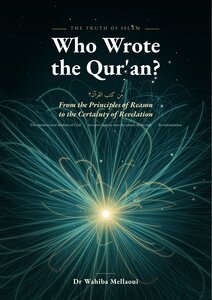
Who Wrote the Qur'an - From the Principles of Reason to the Certainty of Revelation (كتاب)
Who wrote the Qur'an? This book does not ask you to believe it, but to verify it.
One of a kind, this book approaches the most debated question about Islam with what has been missing until now: a complete research method, announced in advance, applied rigorously, and reproducible by anyone. It is not a plea, but a genuine inquiry, conducted the way scientific research is conducted.
A clear, visible and reproducible method. The whole approach is presented in one simple diagram, the House of Proof (Bayt al-Burhān). Its foundations are the principles of reason that every human being shares. Above them stands the theory of knowledge: how do we know what we know? Then come recognised research methods used in universities around the world: inference to the best explanation, triangulation, falsifiability and the historians' criteria. Each step rests on the one before it, and the reader always knows where they stand.
A complete inquiry, from beginning to end. The book first establishes, by reason alone, the existence of one Creator, all-knowing and wise, and shows why His wisdom calls for communication with humankind. It then opens the file of the Qur'an: seven hypotheses about the origin of the text, none ruled out in advance, and twelve established facts tested against each of them. A matrix allows readers to redo the comparison themselves. The book also verifies, chain by chain, how the text was transmitted to us. Finally, it faces the strongest objections, from the problem of evil to human freedom.
Rare honesty. The criteria are set before the evidence is examined, never after. The limits of every argument are flagged in transparency boxes. Objections are presented in their strongest form, and the author applies to her own reasoning the rules she asks others to respect.
An invitation to critical thinking. Because the method is clear and reproducible, every conclusion can be checked, discussed and challenged. The book thus opens the way to a serious, high-level debate between believers and sceptics, with respect for everyone.
A book for learning and teaching. Diagrams, tables, chapter summaries and a glossary make it suitable for universities, Islamic centres, and courses in comparative religion, philosophy and research methodology. It remains accessible to any curious reader, without special training.
Whether you are a Muslim who wants to know the full rational strength of your faith, a sceptic looking for serious arguments, a student or a teacher, this book gives you the tools to judge for yourself.
About the author. Dr Wahiba Mellaoui is a computer engineer and holds a PhD in engineering from Seoul National University. As a visiting professor of research methodology at the University of Algiers 1, she taught systematic literature review to new university lecturers. She reviews articles for international journals, including Human Resource Management Journal, Electronic Markets, and Electronic Commerce Research, as well as academic books. In 2025 she sat on a doctoral defence committee at Seoul National University. Winner of a best research paper award (2022), she is the lead author of Homo-Servus: The Collapse of Human Sovereignty in the Digital Era, a peer-reviewed book forthcoming. She brings this experience to this book: a transparent path that readers can follow, retrace, and discuss.


