كتب end of science our last three wishes
اذا لم تجد ما تبحث عنه يمكنك استخدام كلمات أكثر دقة.
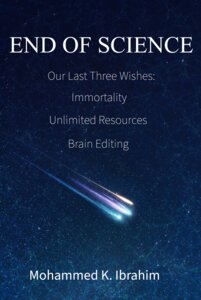
END OF SCIENCE : Our Last Three Wishes (كتاب)
Science depends on a set of conditions in order to progress: funding, group work, a peaceful environment, and a desire for knowledge. The absence of all except the last can slow down the development of science considerably, only the last one can end it definitively. The word philosophy comes from the Greek origin meaning “ the love of wisdom”, but what if we no longer loved receiving wisdom? This book hypothesizes such a scenario in the near future through technologies that satisfy human desire and therefore eliminate the need to pursue science altogether. Technologies such as genetic engineering have the potential to virtually immortalize us by getting rid of diseases, disorders, and cell senescence, AI robotics can build spaceships in a more efficient and less costly manner and pilot them with accuracy. And brain-computer interface technologies could connect us with machines and give our mind power beyond our physical bodies. All these suggest that a technological revolution will end science, not a fundamental change in it nor a limit of our knowledge of it because these technologies satisfy what human nature was looking for in science from the start. We already have these technologies in our hands, however, we haven’t developed them enough to actualize these wishes even though it is moving at a pretty well pace towards them. We naturally seek – as all living beings do – life as never-ending and abundant resources as long as we are alive, achieving these two goals of life could bleed science to the point of almost dying, but the ultimate weapon comes when we can edit our brains to add-remove memories or neural networks from it, which not only makes immortality boredom-less but it has the potential to achieve the previous two goals with the least energy possible. The extensive history discussed in the book and the advances that these technologies might bring up in the future work as given facts to predict how it will affect scientific pursuit. I hope the reader understands that this book is a mere thesis (accessible to criticism) out of many that present an explanation for possible human abandonment of science.