المتوازيات والمفارقات: استكشافات في الموسيقى والمجتمع

ترقية حسابك
التحميل مجاناً لكن نقدم بعض الخدمات المدفوعة ادعمنا بالإشتراك فيها
حذف الإعلانات وتسريع تصفح المكتبة.
يبدأ التحميل بضغطة زر دون انتظار تجهيز الكتاب.
لا حدود لمرات التحميل.
يمكنك رفع كتب بلا حدود بالمكتبة.
تمكين القراء من تحميل كتبك دون إنتظار.
حذف الاعلانات على الكتب التي تنشرها.
لا مشاكل في روابط التحميل لكتبك المرفوعة.
كتاب المتوازيات والمفارقات استكشافات في الموسيقى والمجتمع
حقوق النشر محفوظة
لا يمكن قراءة الكتاب أو تحميله حفاظاً على حقوق نشر المؤلف و دار النشر
غير متوفر رقمياً أو ورقياً من خلال مكتبة نور، متروك للتقييم والمراجعة



المتوازيات والمفارقات: استكشافات في الموسيقى والمجتمع
| مؤلف: | ادوارد دبليو. اسعيد |
| قسم: | آلات الموسيقى والعزف [تعديل] |
| اللغة: | الإنجليزية |
| الناشر: | Vintage |
| ردمك ISBN: | 1400075157 |
| تاريخ الإصدار: | 01 يناير 2004 |
| ترتيب الشهرة: | 630,120 رقم 1 هو الأشهر ! |
| رابط مختصر: | نسخ |
| المزيد من الكتب مثل هذا الكتاب | |

ادوارد دبليو. اسعيد
المؤلف كتاب المتوازيات والمفارقات: استكشافات في الموسيقى والمجتمع والمؤلف لـ 28 كتب أخرى.
(Arabic Profile إدوارد سعيد)
Edward Wadie Said was a professor of literature at Columbia University, a public intellectual, and a founder of the academic field of postcolonial studies. A Palestinian American born in Mandatory Palestine, he was a citizen of the United States by way of his father, a U.S. Army veteran.
Educated in the Western canon, at British and American schools, Said applied his ed (Arabic Profile إدوارد سعيد)
Edward Wadie Said was a professor of literature at Columbia University, a public intellectual, and a founder of the academic field of postcolonial studies. A Palestinian American born in Mandatory Palestine, he was a citizen of the United States by way of his father, a U.S. Army veteran.
Educated in the Western canon, at British and American schools, Said applied his education and bi-cultural perspective to illuminating the gaps of cultural and political understanding between the Western world and the Eastern world, especially about the Israeli-Palestinian conflict in the Middle East; his principal influences were Antonio Gramsci, Frantz Fanon, Aimé Césaire, Michel Foucault, and Theodor Adorno.
As a cultural critic, Said is known for the book Orientalism (1978), a critique of the cultural representations that are the bases of Orientalism—how the Western world perceives the Orient. Said’s model of textual analysis transformed the academic discourse of researchers in literary theory, literary criticism, and Middle-Eastern studies—how academics examine, describe, and define the cultures being studied. As a foundational text, Orientalism was controversial among the scholars of Oriental Studies, philosophy, and literature.
As a public intellectual, Said was a controversial member of the Palestinian National Council, because he publicly criticized Israel and the Arab countries, especially the political and cultural policies of Muslim régimes who acted against the national interests of their peoples. Said advocated the establishment of a Palestinian state to ensure equal political and human rights for the Palestinians in Israel, including the right of return to the homeland. He defined his oppositional relation with the status quo as the remit of the public intellectual who has “to sift, to judge, to criticize, to choose, so that choice and agency return to the individual” man and woman.
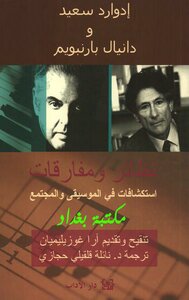
In 1999, with his friend Daniel Barenboim, Said co-founded the West–Eastern Divan Orchestra, based in Seville, which comprises young Israeli, Palestinian, and Arab musicians. Besides being an academic, Said also was an accomplished pianist, and, with Barenboim, co-authored the book Parallels and Paradoxes: Explorations in Music and Society (2002), a compilation of their conversations about music. Edward Said died of leukemia on 25 September 2003.
وصف الكتاب
These free-wheeling, often exhilarating dialogues—which grew out of the acclaimed Carnegie Hall Talks—are an exchange between two of the most prominent figures in contemporary culture: Daniel Barenboim, internationally renowned conductor and pianist, and Edward W. Said, eminent literary critic and impassioned commentator on the Middle East. Barenboim is an Argentinian-Israeli and Said a Palestinian-American; they are also close friends. As they range across music, literature, and society, they open up many fields of inquiry: the importance of a sense of place; music as a defiance of silence; the legacies of artists from Mozart and Beethoven to Dickens and Adorno; Wagner’s anti-Semitism; and the need for “artistic solutions” to the predicament of the Middle East—something they both witnessed when they brought young Arab and Israeli musicians together. Erudite, intimate, thoughtful and spontaneous, Parallels and Paradoxes is a virtuosic collaboration.

حقوق النشر محفوظة
لا يمكن قراءة الكتاب أو تحميله حفاظاً على حقوق نشر المؤلف و دار النشر
غير متوفر رقمياً أو ورقياً من خلال مكتبة نور، متروك للتقييم والمراجعة
شارك الكتاب :
مراجعة كتاب "المتوازيات والمفارقات: استكشافات في الموسيقى والمجتمع"

اقتباسات كتاب "المتوازيات والمفارقات: استكشافات في الموسيقى والمجتمع"

كتب أخرى مثل "المتوازيات والمفارقات: استكشافات في الموسيقى والمجتمع"









كتب أخرى لـ "ادوارد دبليو. اسعيد"




فى حالة وجود مشكلة بالكتاب الرجاء الإبلاغ من خلال أحد الروابط التالية:
بلّغ عن الكتاب أو من خلال التواصل معنا
الكتب الإلكترونية هي مكملة وداعمة للكتب الورقية ولا تلغيه أبداً بضغطة زر يصل الكتاب الإلكتروني لأي شخص بأي مكان بالعالم.
قد يضعف نظرك بسبب توهج الشاشة، أدعم ناشر الكتاب بشراءك لكتابه الورقي الأصلي إذا تمكنت من الوصول له والحصول عليه فلا تتردد بشراءه.
أنشر كتابك الآن مجانا